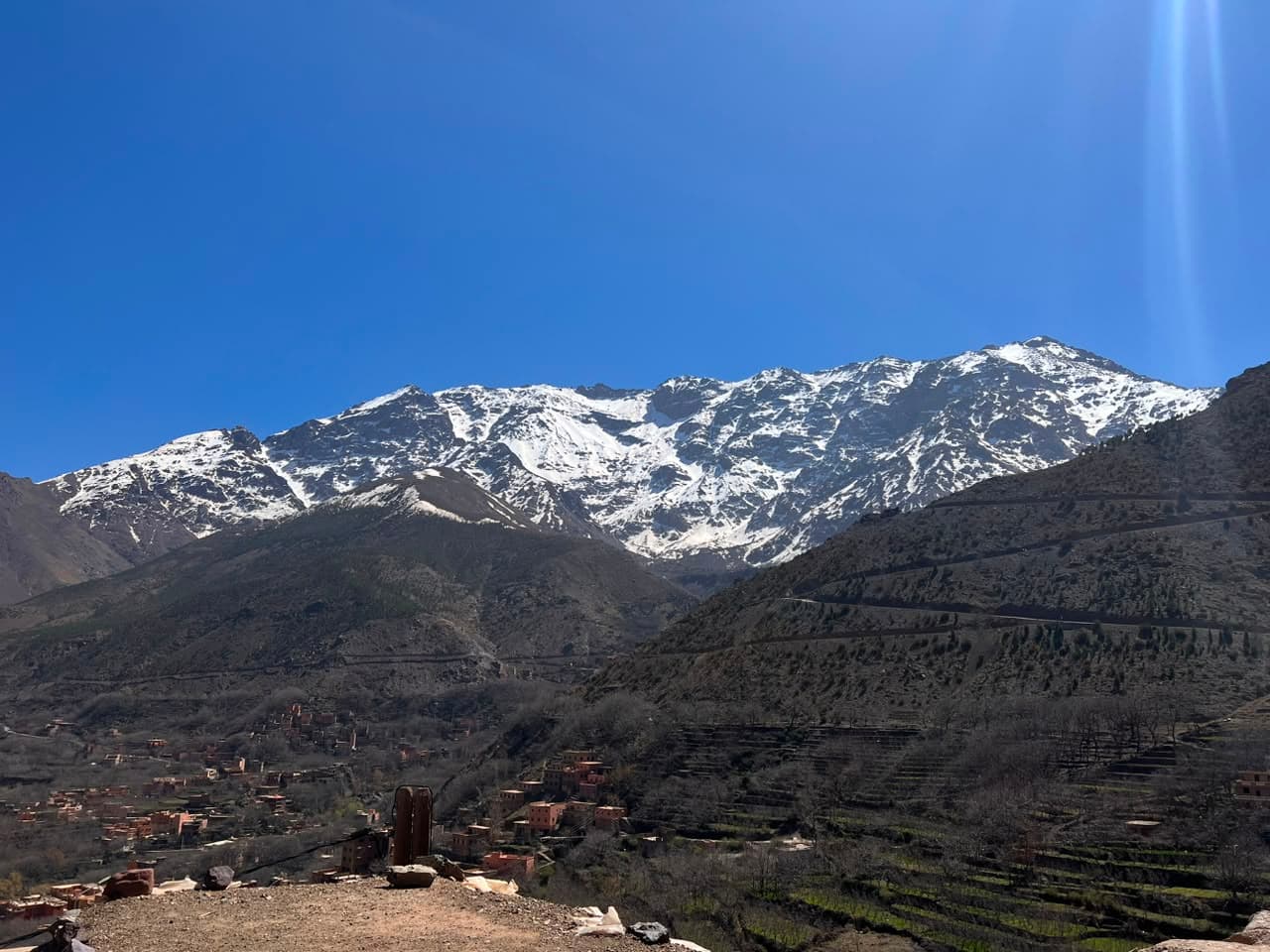
Snow turns Toubkal from a walk-up into a proper winter mountain: crampons, an ice axe, and a steeper set of consequences. Whether a fit beginner can do it, and what changes between November and April.
Winter is a different mountain
In May, Jbel Toubkal is a long walk on a rough path. In February, it is a winter mountain that happens to be non-technical. Same route, same altitude, different set of consequences.
That distinction is the whole point of this article. Plenty of people book winter Toubkal having read a summer trip report, and arrive with summer expectations. The mountain does not grade on a curve.
When the snow arrives
Snow generally lies on the summit cone from November to April, with the most reliable conditions in January and February. But it varies more than people expect:
- A warm winter can leave the upper mountain thin and rocky into January.
- A cold one brings snow down to Imlil itself at 1,740 m.
- Late-season snow in March and April is often softer, which is pleasant to walk on and more prone to sliding.
Nobody can tell you in October what February will look like. Any guide who gives you a confident forecast that far out is guessing.
What actually changes
The summit cone
This is the part that matters. Above the refuge, the route climbs a broad slope of scree that, under snow, becomes a firm, uniform incline. It is not steep enough to be climbing. It is absolutely steep enough that an uncontrolled slip carries you a long way into rocks.
That single fact is why an ice axe is not optional. The axe is what stops the slide.
Crampons and an axe
Both are required in winter, and both can be hired in Imlil or come with a guided package. If you have never used them, that is fine and expected. What is not fine is arriving without having accepted that you will need to learn.
Good operators build in a training session on the day before the summit bid: how to walk in crampons without catching a point on your own gaiter, how to hold the axe on a traverse, and how to self-arrest. It takes an afternoon to get functional.
Self-arrest is the actual skill that matters, so it is worth understanding what it is rather than treating it as jargon. It is the technique for stopping yourself if you slip and start sliding down a snow slope: rolling onto your front, driving the pick of the ice axe into the snow above your shoulder, and using your body weight to lever it in as a brake while keeping your legs and crampon points up off the snow — catching a crampon point while sliding is how ankles break. It is a physical, repeatable drill rather than an abstract idea, which is exactly why a proper guide has you practise it on a safe, low-angle slope near the refuge before you are anywhere near a slope where you would actually need it.
The refuge
The Toubkal refuge at 3,207 m is open through winter and heated, but "heated" is doing modest work in that sentence. Bring a real sleeping bag. Water freezes overnight.
The days
Summit day runs 8 to 12 hours in winter, against roughly 6 to 8 in summer. Snow is slow. You start in the dark and you may finish in it.
Can a beginner do it?
Yes, with two honest caveats.
The first is fitness, and it is non-negotiable. Winter Toubkal asks for 6 to 8 hours of movement on rough ground, at altitude, in cold, carrying a pack, for several consecutive days. No skill compensates for not having the engine. If you cannot comfortably do a long hill day at home, you will have a miserable time here.
The second is that "beginner" means beginner at winter skills, not beginner at hiking. Guides teach crampon and axe technique on the trip, and that system works. It works because the clients arrive fit and willing to learn. It does not work for someone whose longest walk this year was around a city.
If you are a regular hillwalker who has never touched an ice axe, winter Toubkal is a genuinely good introduction to winter mountaineering. If you are new to both, do it in spring instead. The mountain is not going anywhere.
Altitude, briefly
Toubkal is 4,167 m — high enough to feel, well below the altitudes where things get dangerous fast. Serious altitude sickness is uncommon here. Mild headaches and poor sleep at the refuge are normal and not a cause for alarm.
The main mitigation is pace, which is one more argument for a guide: a good one walks slower than you want to, on purpose.
What to bring that summer does not need
- Insulated boots stiff enough to take a crampon. Flexible summer walking boots will not hold a crampon properly. This is the single most common gear failure.
- A four-season sleeping bag for the refuge.
- Goggles or good sunglasses. Snow glare at 4,000 m is brutal.
- Insulated gloves, plus spares. Wet gloves at minus 15 stop being gloves.
- A vacuum flask. Cold water is unappealing and people stop drinking; dehydration then does the work altitude gets blamed for.
Our 4-day Toubkal trek runs through winter with crampons, axes, and the training session included, and the 2-day version compresses it for experienced hill walkers who do not need the acclimatisation day.
Is it worth it?
The High Atlas in winter is genuinely one of the great sights in North Africa: the whole range white, the Sahara haze to the south, and almost nobody on the mountain. Summer Toubkal is busy. February Toubkal is not.
It is harder, colder, and less certain than the same trek in May. If that reads as a deterrent, go in spring, and you will have a lovely time. If it reads as the appeal, this is your season.
Not sure which side of that line you fall on? Tell us what you have done before and we will give you a straight answer, including if that answer is to wait a year.
Frequently asked questions
Can a beginner climb Toubkal in winter?
Do you need crampons and an ice axe on Toubkal in winter?
When is Toubkal covered in snow?
Is winter the best time to climb Toubkal?
How cold does it get on Toubkal in winter?
Trips that go here
Guided by the team who wrote this guide.
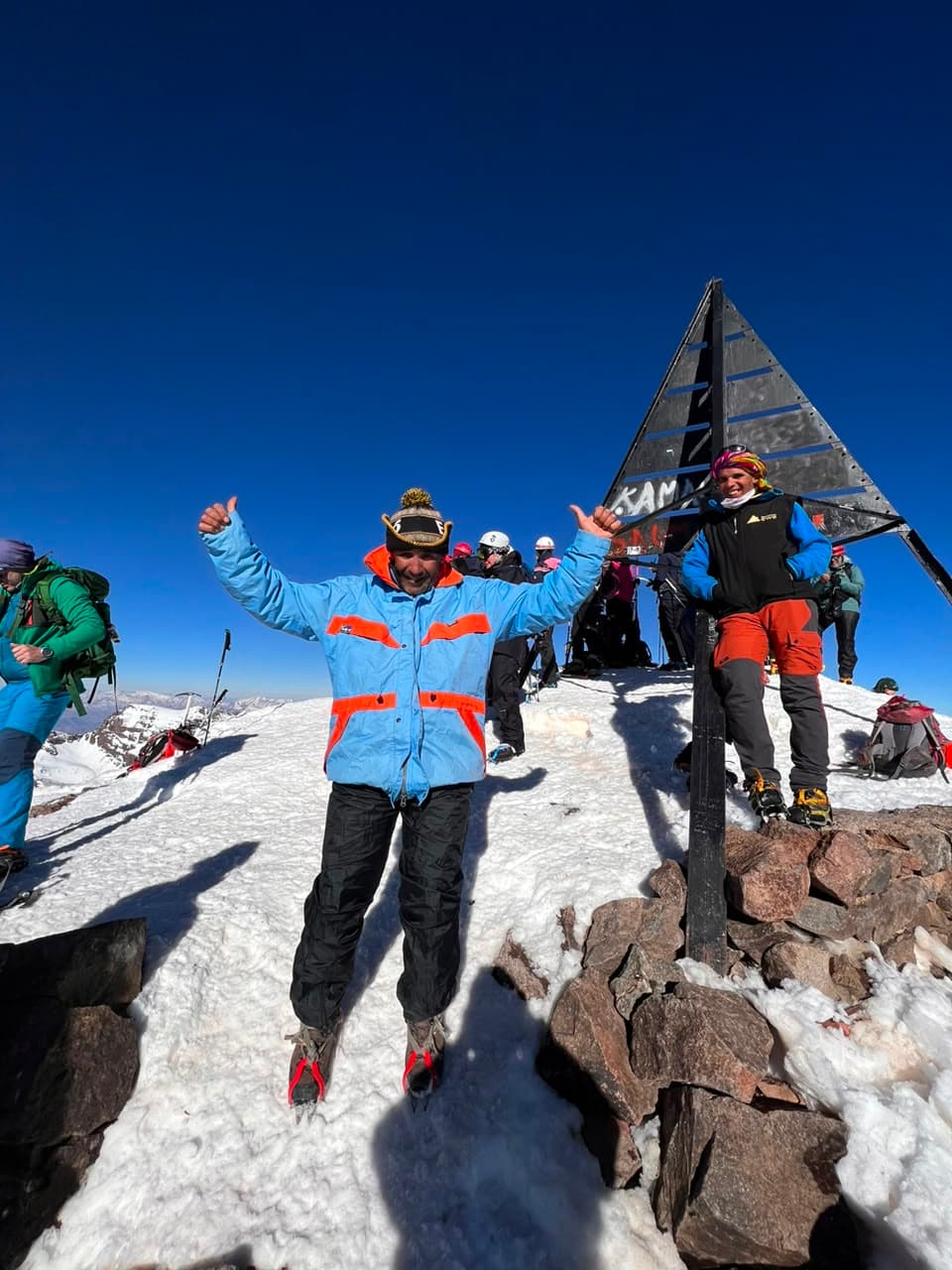
4-Day Toubkal Summit Trek from Marrakech
- Summit Jbel Toubkal at 4,167 m — highest peak in North Africa
- Sleep in traditional Berber mountain refuges at 3,207 m
- Start in the trailhead village of Imlil, deep in the Atlas
€260 / person for 6+
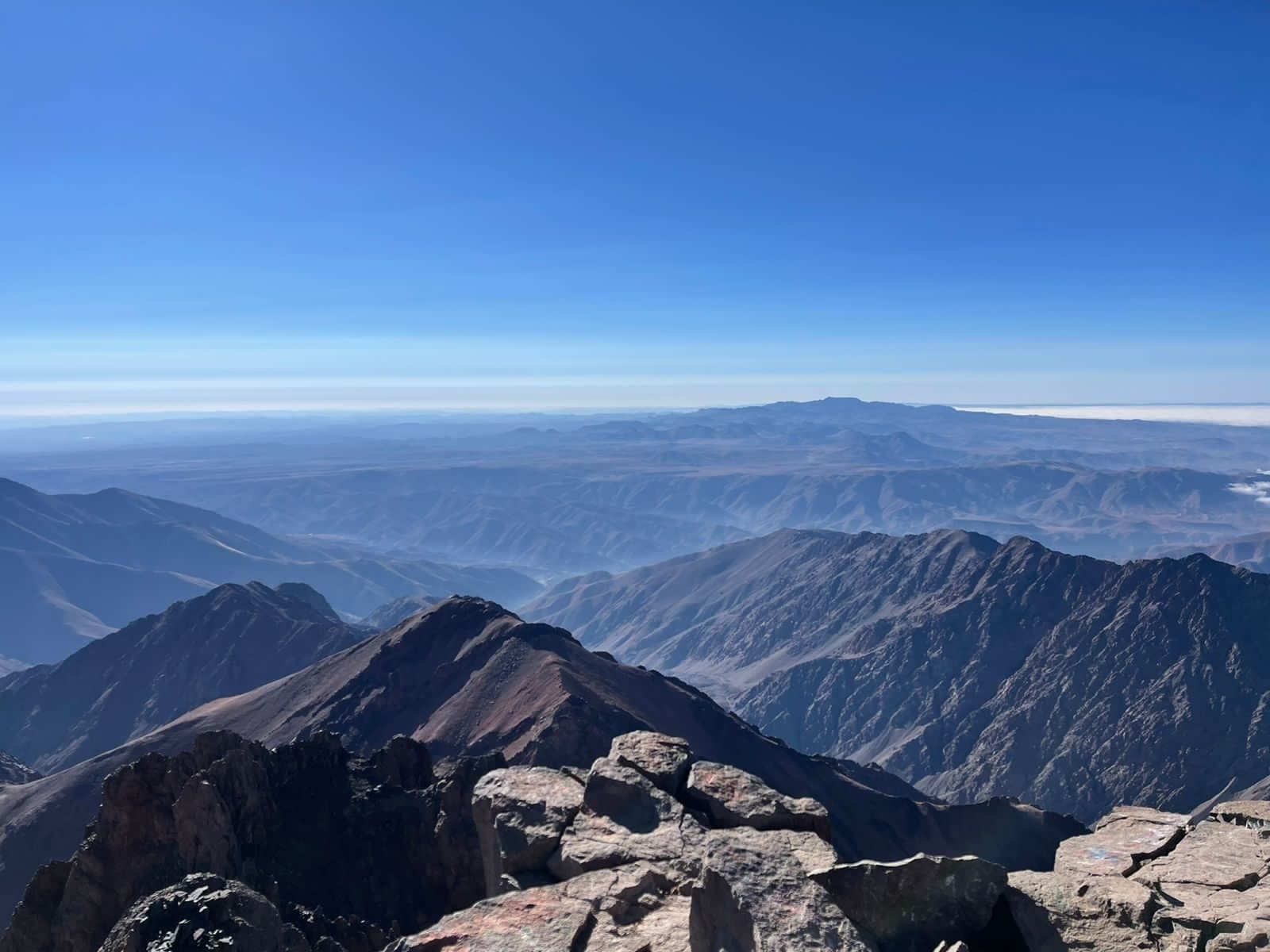
Mount Toubkal Express — 2-Day Summit from Marrakech
- Summit Jbel Toubkal (4,167 m) in just two days from Marrakech
- Overnight in the Toubkal Refuge at 3,207 m
- Pass the Sidi Chamharouch shrine and its waterfall
€153 / person for 6+