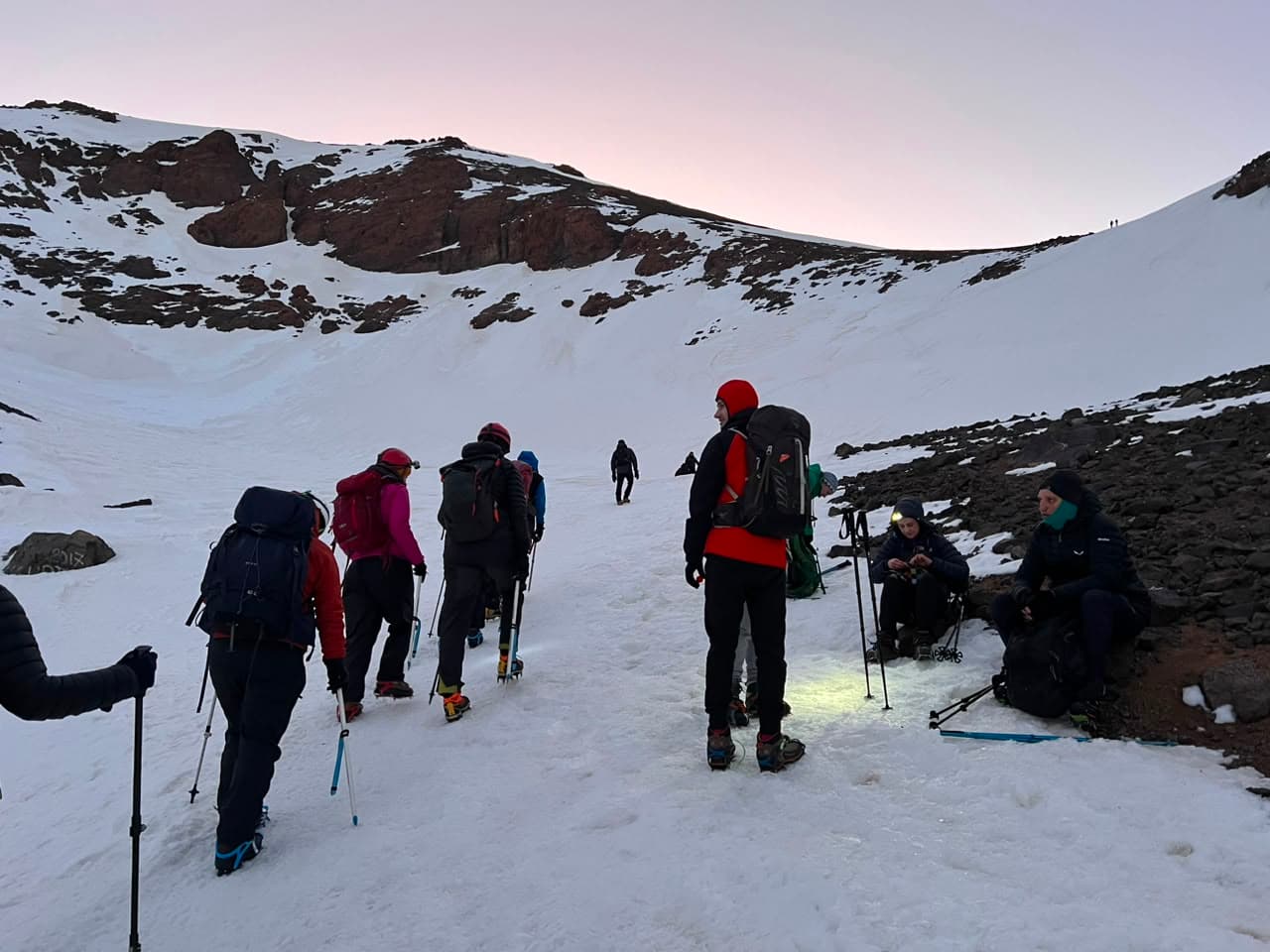
At 4,167 metres, Jbel Toubkal is the highest peak in North Africa. Here is everything you need to know — best season, fitness requirements, gear list, and what to expect on summit day.
What Is Jbel Toubkal?
Jbel Toubkal (4,167 m / 13,671 ft) is the highest mountain in Morocco and the highest peak in North Africa. It sits in the High Atlas range, roughly 70 km south of Marrakech, and can be reached from the mountain village of Imlil in around two days of trekking.
Unlike the technical routes of the Alps or Himalayas, Toubkal is a non-technical climb — no ropes, no ice axes in summer — which makes it accessible to fit hikers with no mountaineering experience. That said, the altitude, distance, and steep scree demand genuine physical preparation.
Best Season to Climb
May–October is the main trekking window. July and August are the most popular months: the snow has melted on the South Cirque route, days are long, and skies are reliably clear. The trade-off is heat in the lower valleys and slightly more trekkers at the refuge.
September and October are arguably the finest months — the summer crowds thin out, temperatures are comfortable, and the High Atlas wildflowers are still blooming. We consider October the sweet spot.
November–April: Winter ascents are possible but require crampons, an ice axe, and experience with snow travel. The summit area can hold ice well into May. Do not attempt the winter route without a certified alpine guide.
Fitness Requirements
Toubkal is graded challenging. You should be able to:
- Walk 6–8 hours per day carrying a daypack (5–8 kg)
- Climb 1,000 m+ of vertical gain in a single day comfortably
- Handle exposed scree trails and rocky ridgelines
Prior hiking experience is expected. Those who have never hiked a mountain before should consider the Ourika Valley day hike first to gauge their baseline.
The Standard 4-Day Itinerary
Day 1 — Marrakech to Imlil (1,740 m)
Transfer from Marrakech (1.5 hours) to Imlil, the trailhead village. Meet your guide, settle in, and take a short walk through the terraced Berber fields to start acclimatising. Welcome dinner.
Day 2 — Imlil to Toubkal Refuge (3,207 m)
The key acclimatisation day. Ascend through the Mizane Valley, passing the shrine of Sidi Chamharouch. Arrive at the refuge by early afternoon. Light walk for acclimatisation. Early to bed.
Day 3 — Summit Day (4,167 m)
Pre-dawn start, typically 4:30–5:00 am. The South Cirque route ascends via steep scree and rocky switchbacks. Most groups reach the summit in 3–4 hours. Sunrise from the summit is one of the greatest views in Africa — on a clear day, the Sahara is visible to the south and the Atlantic to the west. Descent back to the refuge, then down to Imlil.
Day 4 — Imlil to Marrakech
Morning descent through walnut groves and terraced fields. Transfer back to Marrakech by early afternoon.
What to Pack
Essentials
- Broken-in hiking boots with ankle support (mandatory)
- Trekking poles (strongly recommended — the scree descent is hard on knees)
- Warm mid-layer and waterproof jacket (temperatures drop below 0°C at the refuge even in summer)
- Headlamp with spare batteries
- Sunscreen SPF 50+ and glacier glasses
Clothing (layering system)
- Moisture-wicking base layer
- Fleece or down mid-layer
- Waterproof and windproof shell
- Warm hat and gloves for the summit
Documents
- Passport (required for refuge registration)
- Travel insurance with altitude cover
The Refuge
The Toubkal Refuge (CAF Refuge, 3,207 m) is a managed mountain hut with dormitory-style bunk beds, blankets, hot showers, and cooked meals. It is basic but fully functional. Booking in advance during July–August is essential.
Why a Guide Is Not Optional Here
This is worth being direct about, because older articles online still describe Toubkal as an independent trek and that information is out of date. Following the killing of two foreign tourists near Imlil in December 2018 — an attack that shocked Morocco's trekking community and prompted a real policy response, not just a symbolic one — the authorities introduced a requirement, enforced from around 2019 onward, that every foreign trekker on the Imlil–Toubkal route be accompanied by a licensed guide. Checkpoints on the trail confirm this, and it is not a formality you can talk your way around.
Separate from the legal requirement, a certified guide adds real value on a mountain like this:
- Navigation on summit day in poor visibility
- Local knowledge of weather patterns (storms build fast on the summit plateau)
- Access to vetted local porters and mule teams
- Language support in villages
All our guides are certified by the Moroccan Ministry of Tourism and hold first-aid qualifications.
Frequently Asked Questions
Do I need a visa for Morocco?
Citizens of the EU, USA, UK, Canada, and most Western countries do not need a visa for stays under 90 days.
Can I do Toubkal in 2 days?
A 2-day ascent is possible (Imlil → Refuge → Summit → Imlil) but removes any acclimatisation time, significantly increasing the risk of altitude sickness. We recommend 3 or 4 days.
Is altitude sickness a risk?
Yes. Toubkal's summit sits at 4,167 m — high enough for acute mountain sickness in some people. Ascending slowly, drinking 3–4 litres of water per day, and not rushing Day 2 are the key preventive measures.
The plane wreck on Tibherine
Trekkers on the Toubkal massif often come back asking about the aircraft
engine sitting on a summit east of the main peak. It is real, and the story
behind it is worth knowing.
On the night of 28 November 1969 a Lockheed L-749A Constellation flying from
Faro in Portugal towards Sao Tome — carrying ammunition bound for Biafra —
lost engine power over Morocco. The crew asked to divert, but the aircraft
lost height and struck Tibherine East at around 3,880 m. All eight people on
board were killed. The wreck was not found until 18 July 1970, when
mountaineers came across it; debris is scattered down the west face, and one
of the engines remains embedded in the summit rocks.
Tibherine is a twin summit — East at 3,880 m and West at 3,887 m, close enough
in height and shape that they are known locally as the twins. The wreck is on
the eastern top.
It is not on the standard Toubkal route. Our summit treks go to Toubkal
itself and return to the refuge, so reaching the wreck means a separate
objective and a guide who knows the approach. If seeing it matters to you, say
so when you enquire and we will tell you honestly whether it fits the itinerary
you are considering — on a two-day trek, it does not.
The full story of the crash, and why most accounts of it get the details wrong, is in
Frequently asked questions
Do you need a guide to climb Toubkal?
How fit do you need to be to climb Toubkal?
How many days do you need to climb Toubkal?
What is the Toubkal Refuge like?
What is the best time of year to climb Toubkal?
How much does it cost to climb Toubkal?
Can a beginner climb Toubkal?
What is the success rate on Toubkal?
Do you need a permit to climb Toubkal?
Is Toubkal harder than Kilimanjaro?
What altitude is the Toubkal Refuge?
Does the Toubkal trek start from Imlil?
Do mules carry your bags on the trek?
Do I need hiking boots for an Atlas trek?
Do you need crampons for Toubkal?
Trips that go here
Guided by the team who wrote this guide.

4-Day Toubkal Summit Trek from Marrakech
- Summit Jbel Toubkal at 4,167 m — highest peak in North Africa
- Sleep in traditional Berber mountain refuges at 3,207 m
- Start in the trailhead village of Imlil, deep in the Atlas
€260 / person for 6+
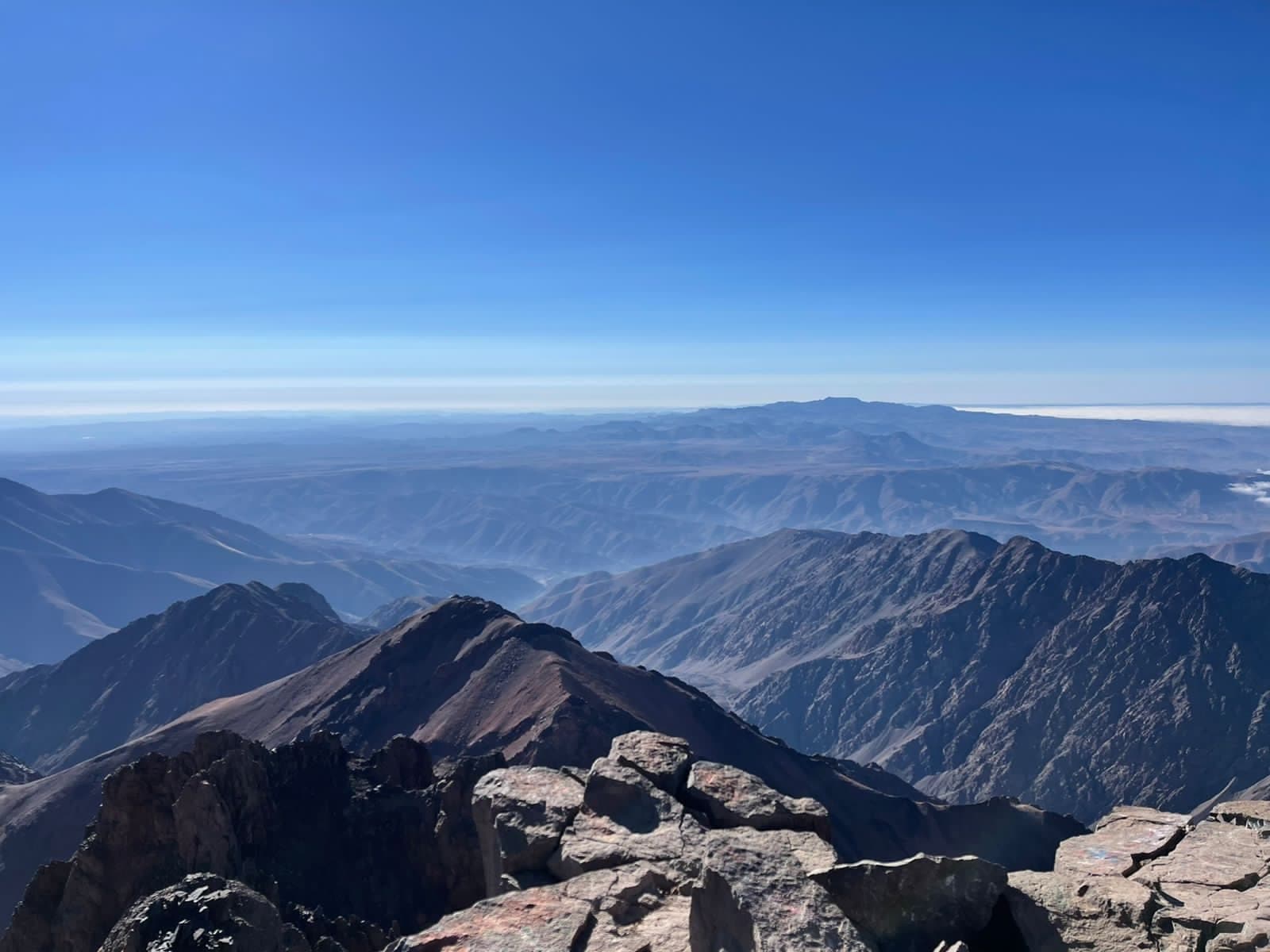
Mount Toubkal Express — 2-Day Summit from Marrakech
- Summit Jbel Toubkal (4,167 m) in just two days from Marrakech
- Overnight in the Toubkal Refuge at 3,207 m
- Pass the Sidi Chamharouch shrine and its waterfall
€153 / person for 6+
8-Day Morocco Highlights: Toubkal Summit and Sahara Desert
- Summit Jbel Toubkal at 4,167 m -- the highest peak in North Africa
- Sleep at the Toubkal refuge (3,207 m) and at Gite Panorama in Imlil
- Ait Ben Haddou, the UNESCO-listed earthen kasbah on the old caravan road
€889 / person