Every operator says 'traditional Berber camp'. That tells you nothing. Here is what the tents are actually like, whether the bathroom is private, what the food is, and how cold it gets at night.
Every desert tour listing in Morocco says the same thing: a night in a traditional Berber camp under the stars. It is technically true of a tent with a foam mattress and a shared latrine, and equally true of a tent with a private bathroom and a proper bed. The phrase does not distinguish them, and the price often does not either.
This is what actually varies, and what to ask before you book.
The tent
The word "tent" covers a lot of ground. What you should establish is two separate things, because operators sometimes blur them.
Is the tent private to your group? On most camps, yes. You get your own tent, and your family or party is not sharing it with strangers. This is normal and you should expect it.
Does the tent have its own bathroom? This is the real variable. At the camps we use for our private desert tours — Sahara Garden, in the Erg Chebbi dunes — each tent has a private bathroom with a shower and a flushing toilet, inside the tent. At standard camps on shared departures, you typically get a private sleeping tent but a shared washing block a short walk away.
Neither is wrong. A shared block is entirely civilised and is part of why a shared departure costs a third of a private one. But they are different products, and you should know which you are buying.
Ask the question directly, and ask for the answer in writing. Any operator who will not name the camp and state the bathroom arrangement is telling you something. How booking works covers what a written confirmation should contain.
The bed
Beds in the better camps are proper beds — a frame, a mattress, sheets and a pile of heavy wool blankets. In simpler camps you may get a thick foam mattress on a rug. Both sleep well after a day on the road; the difference is felt more at the moment you sit down than at the moment you fall asleep.
Blankets are always provided, and always more than you think you will need. Take them.
Getting there
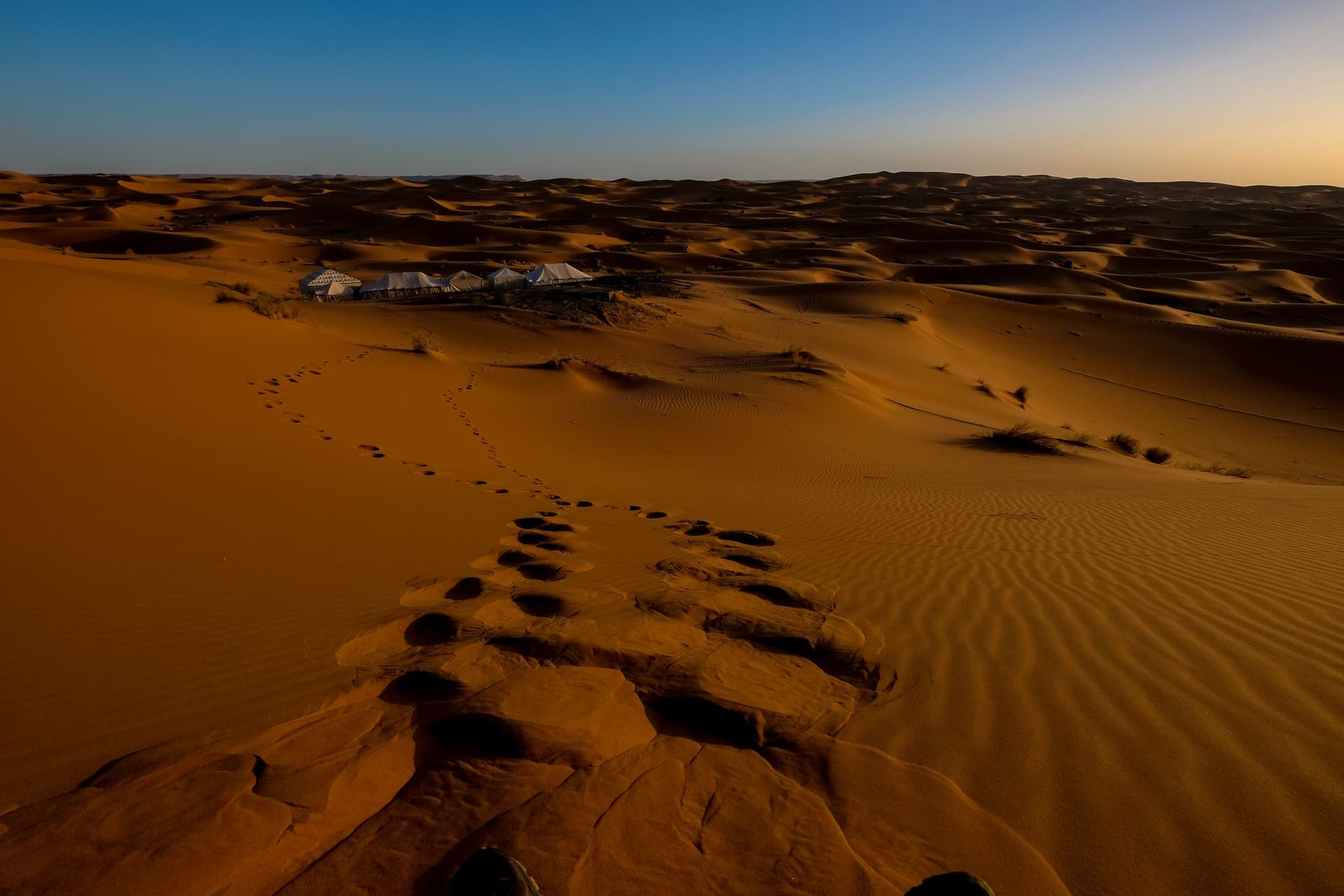
At Erg Chebbi you reach the camp by camel, setting out in the late afternoon so you arrive as the sun goes down. The ride is around 45 minutes to an hour depending on the camp's position in the dunes.
If someone in your party cannot or would rather not ride — a bad back, a nervous child, an older traveller, or simply no interest — say so at booking. A 4x4 can take you in instead, and the rest of the group can still ride. This is a normal request and no camp we work with finds it awkward. It is much easier arranged in advance than negotiated at the trailhead.
The evening
Dinner is a tagine, cooked at camp. Bread, salad, fruit, mint tea. It is simple food done properly, and after a day of driving it lands very well.
Afterwards there is usually drumming around a fire. How long it goes on depends on the group. Nobody is obliged to join in and nobody minds if you slip away to look at the sky, which is the real reason to be there — Erg Chebbi is hundreds of kilometres from any significant light source, and on a moonless night the Milky Way is genuinely startling.
The cold
This is the thing people get wrong most often.
Sand does not retain heat. When the sun goes down, the temperature falls fast, and it keeps falling until dawn. A 40C summer day becomes a 20C night. A 22C February afternoon can be close to freezing by the time you get up for sunrise.
Camps supply heavy blankets and the tents hold warmth well. But between dinner and bed you will be outside, and at 5:30am you will be climbing a dune in the dark. Bring a warm layer whatever the season, and in winter bring a hat and something for your hands. Nobody has ever regretted the extra jumper. If you are travelling between December and February, our winter desert guide has the month-by-month numbers.
Power, signal, water
Solar with a generator backup is the norm. Expect lights in the tent and a socket or two in the communal area. Do not plan on charging four devices.
Phone signal at Erg Chebbi is usually good enough for messages. Wifi is rare, and where it exists it is slow. One evening without it is not a hardship.
Bottled water is provided. Showers, where present, run on tanked water — take a short one, for the obvious reason.
What to bring
- A warm layer, and in winter a hat and gloves
- A head torch or your phone for finding the bathroom at night
- Sandals or something you can slip on and off
- Any medication you need, in your day bag rather than the main luggage
- A scarf, which is genuinely useful against blown sand
You do not need a sleeping bag. You do not need to bring water. You do not need hiking boots for the camp itself.
Luxury camps, and whether they are worth it
Most operators, ourselves included, offer an upgrade to a "luxury" camp. What you are actually buying is a larger tent, a proper en-suite bathroom, better furniture, and usually a quieter position in the dunes.
Whether that is worth the supplement depends entirely on you. If you sleep badly in unfamiliar places, if you are travelling with someone who would find a shared bathroom genuinely difficult, or if this is the one big night of the trip, it is money well spent. If you are young, easy-going, and out there for the dunes rather than the bedding, the standard camp does the same job.
We have written about the difference in more detail in our luxury versus standard desert camp guide.
The honest summary
A desert camp is not a hotel and is not trying to be. It is a good bed, a good dinner and an extraordinary sky, in a place it takes real effort to reach.
The things that go wrong are almost always expectation failures rather than camp failures — someone who assumed a private bathroom and got a shared one, or who packed for a 40C day and froze at 3am. Both are avoidable by asking two questions before you book.
Private 3-day desert tour · Shared 3-day departure · 4-day desert tour
Frequently asked questions
Do desert camps have private bathrooms?
How cold does the Sahara get at night?
Is there electricity and wifi at a desert camp?
What food is served at a desert camp?
Trips that go here
Guided by the team who wrote this guide.
Marrakech to Merzouga — 3-Day Desert Tour
- Camel trek into Erg Chebbi dunes at sunset
- Overnight in a luxury Berber desert camp
- Stargazing with no light pollution at all
€230 / person for 6+
Merzouga Desert from Marrakech — 3-Day Shared Tour
- Tizi n'Tichka pass through the High Atlas
- UNESCO Ksar of Aït Ben Haddou
- Dades and Todra gorges
€120 / person
Marrakech Desert Grand Tour — 4 Days
- Full night at an Erg Chebbi desert camp — sunset and sunrise camel treks
- Todra Gorge — Morocco's most dramatic canyon (400 m walls, 4 km walk)
- UNESCO Ksar of Aït Ben Haddou — Gladiator and Game of Thrones location
€236 / person for 6+