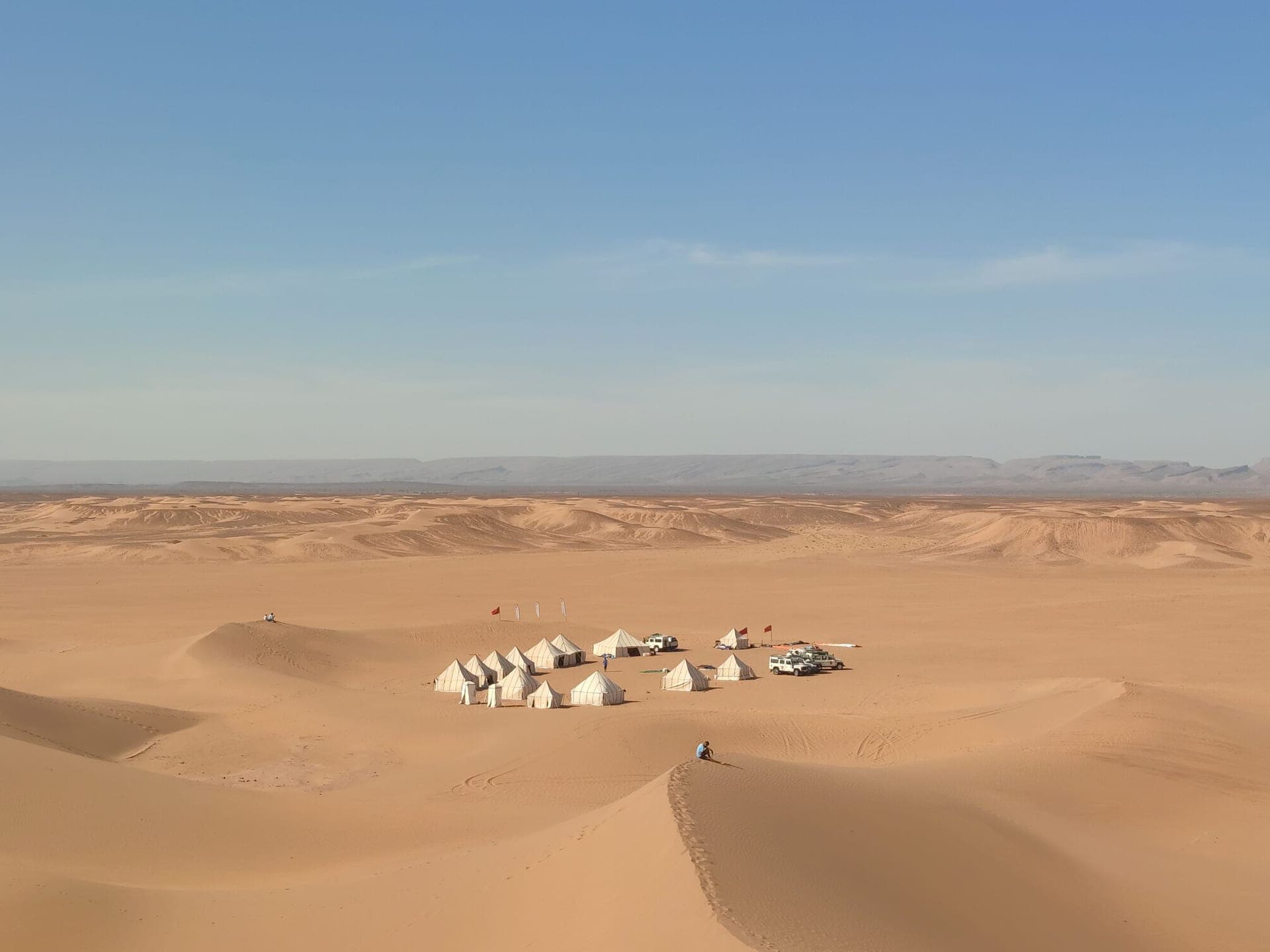
The difference is mostly one thing — whether the bathroom is inside your tent. Here is what each type really offers, what the upgrade costs, and when it is worth paying for and when it is not.
> Before comparing tiers, it is worth knowing what any desert camp is like: what a Sahara desert camp is actually like covers the tents, the bathrooms, the food and the cold.
The short answer
Nearly all of the difference is the bathroom.
A standard camp gives you a proper bed inside a canvas or black wool tent, with
shared toilets and showers in a block a short walk away. A luxury camp gives you the
same dunes, the same dinner, the same sky — and your own bathroom inside your tent, with
a flush toilet and a hot shower.
Everything else that gets listed on the luxury side — bigger beds, rugs, furniture,
heating — follows from the same investment. But if you strip the marketing
away, you are mostly deciding whether you want to walk across sand in the dark at 2am.
What a standard camp is really like
This is what most of our desert tours include, and it is not roughing it:
- A frame bed with a mattress, sheets and blankets, inside a canvas or traditional black
wool tent
- Shared flush toilets and hot showers in a nearby block
- Dinner cooked on site — normally tagine, salads, bread, fruit — and breakfast
- Electricity for lighting and charging, and Wi-Fi
- Drumming and a fire under an extremely dark sky
What it does not give you: privacy in the bathroom, or heating in winter.
Most people who stay in one describe it afterwards as the best night of the trip. The
quiet and the dark sky are a large part of why.
What the luxury upgrade actually buys
- An en-suite bathroom in your tent — flush toilet, sink, hot shower with real
pressure. This is the upgrade; the rest is trimming.
- A larger tent with a proper bed, rugs, seating, sometimes a small terrace
- Heating in winter, air conditioning in summer at the better camps
- Better food, more courses, and usually a quieter, more curated atmosphere
What it does not change: the dunes, the sunset, the stars, the camel ride, the silence.
Those are free and identical at both.
The money, plainly
| Standard | Luxury | |
|---|---|---|
| Market rate per night | €40–€100 | €150–€500 |
| Typical upgrade on a booked tour | — | about €70 per person, per night |
| Bathroom | shared block | en-suite in tent |
| Power and Wi-Fi | yes | yes |
| Climate control | none | heating, often A/C |
Two things worth noticing in that table.
First, the market range for luxury is enormous. €150 and €500 buy genuinely different
experiences, and a camp advertised as "luxury" at the bottom of that range may be a
standard camp with a better bed. Ask specifically whether the bathroom is inside the
tent, because that is the question that actually separates them.
Second, the upgrade is charged per person per night, so it scales fast. For a couple
on a two-night desert trip, it is around €280 — which on our
3-day Sahara tour at €380 per person for two is a substantial
addition to the trip price.
When we would say pay for it
Travelling with young children. The single strongest case. A shared toilet block
across open sand, in the dark, with a five-year-old, is the thing that turns a magical
night into a difficult one. Our [4-day family desert
tour](/en/tours/family-desert-4day-marrakech) is built around a family camp for exactly
this reason, and what a family desert tour costs
sets out the per-person price at each group size.
December to February. Desert nights genuinely drop near freezing. A heated tent is
not a comfort purchase in January, it is the difference between sleeping and not.
If a bad night would spoil the trip. Some people can sleep anywhere. If you are not
one of them, and this is the one desert night of a two-week holiday, buy the sleep.
Mobility issues or medical needs. Walking to a shared block over soft sand at night
is harder than it sounds.
When we would say save the money
One night, decent weather, no children. Standard is genuinely fine in spring and
autumn, and the money is better spent on an extra day of the trip.
If you want the desert as it actually is. The traditional black wool tent is how
people have slept out here for a very long time. A canvas suite with a rain shower is a
hotel room that happens to be in a dune field. Both are pleasant; only one of them is the
Sahara.
On a shared departure. Our [shared 3-day
Merzouga trip](/en/tours/shared-merzouga-3day-marrakech) is €120 per person. Adding €70 a
night for a private bathroom changes what kind of trip you have booked, and at that point
a private tour with a standard camp is often better value.
If it means dropping a day. More time in the desert beats a nicer bathroom, almost
every time. Two nights at Erg Chegaga in a standard camp is a better trip than one night
at Erg Chebbi in a luxury one — see our [Erg Chebbi vs Erg Chegaga
comparison](/en/blog/erg-chebbi-vs-erg-chegaga) for why the remoter dunes are worth the
extra driving.
The question to ask before booking
Camps are described with the words the operator chooses, and "luxury" is not a regulated
term. Before you pay for an upgrade, ask one specific question:
"Is the bathroom inside my tent, or shared?"
That single answer tells you more than any photograph on a listing page. Everything else
— the rugs, the lanterns, the brass tray — appears in the photos of both.
What we book
We use standard Berber camps on most desert departures and say so plainly in each tour's
inclusions rather than leaving it vague. Where a tour includes a luxury or family camp,
that is stated too.
If you want the upgrade, tell us when you book and we will price it for your dates
honestly — including telling you when we think it is not worth it, which for a couple in
April on a single desert night is usually our answer.
👉 See our desert tours — every one lists exactly what
camp is included, because "desert camp" on its own does not tell you what you are buying.
Frequently asked questions
What is the real difference between a luxury and standard desert camp?
How much more does a luxury camp cost?
Is a standard desert camp uncomfortable?
Do luxury camps have electricity and heating?
Which camp should families choose?
Are luxury camps less authentic?
Trips that go here
Guided by the team who wrote this guide.
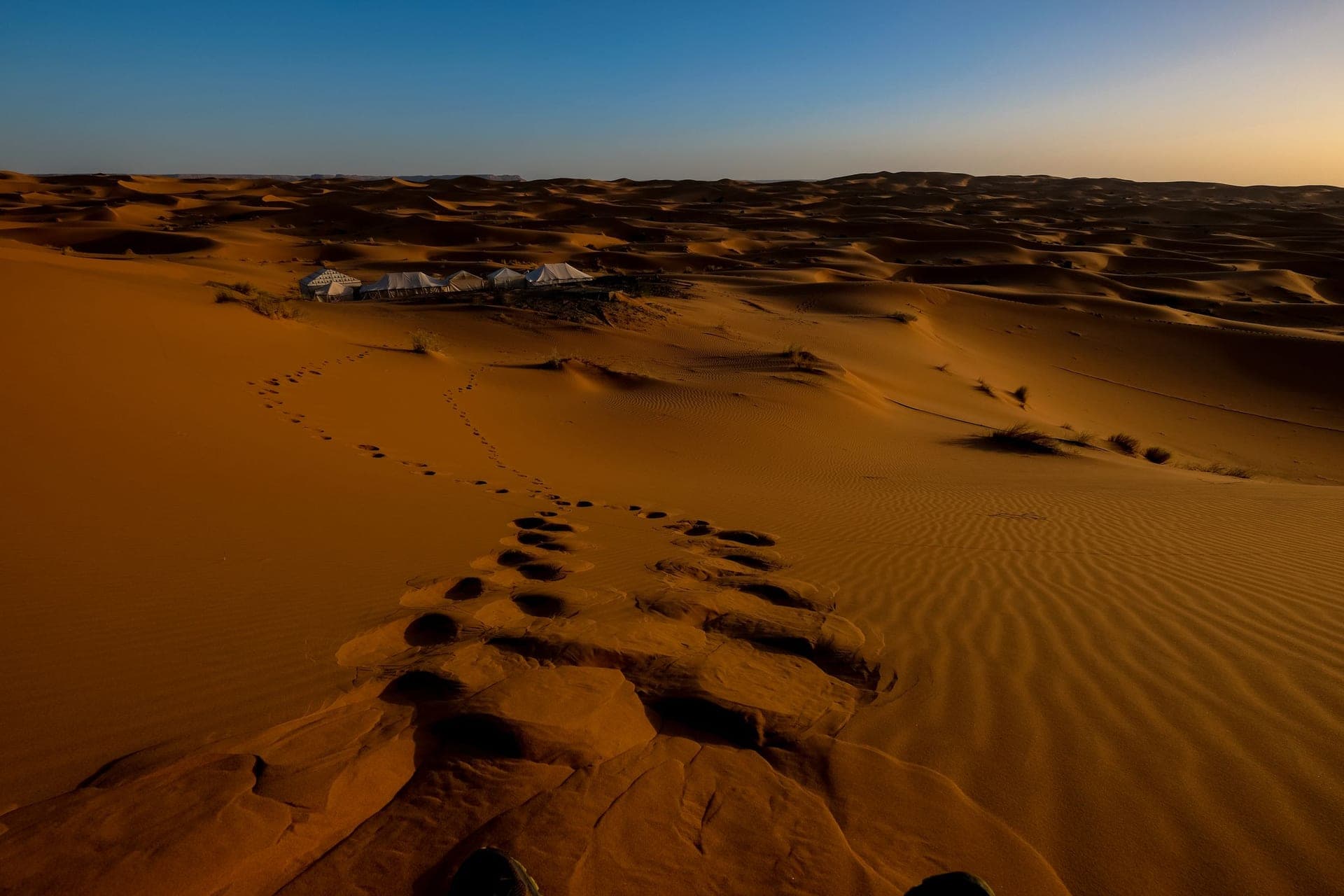
Marrakech to Merzouga — 3-Day Desert Tour
- Camel trek into Erg Chebbi dunes at sunset
- Overnight in a luxury Berber desert camp
- Stargazing with no light pollution at all
€230 / person for 6+
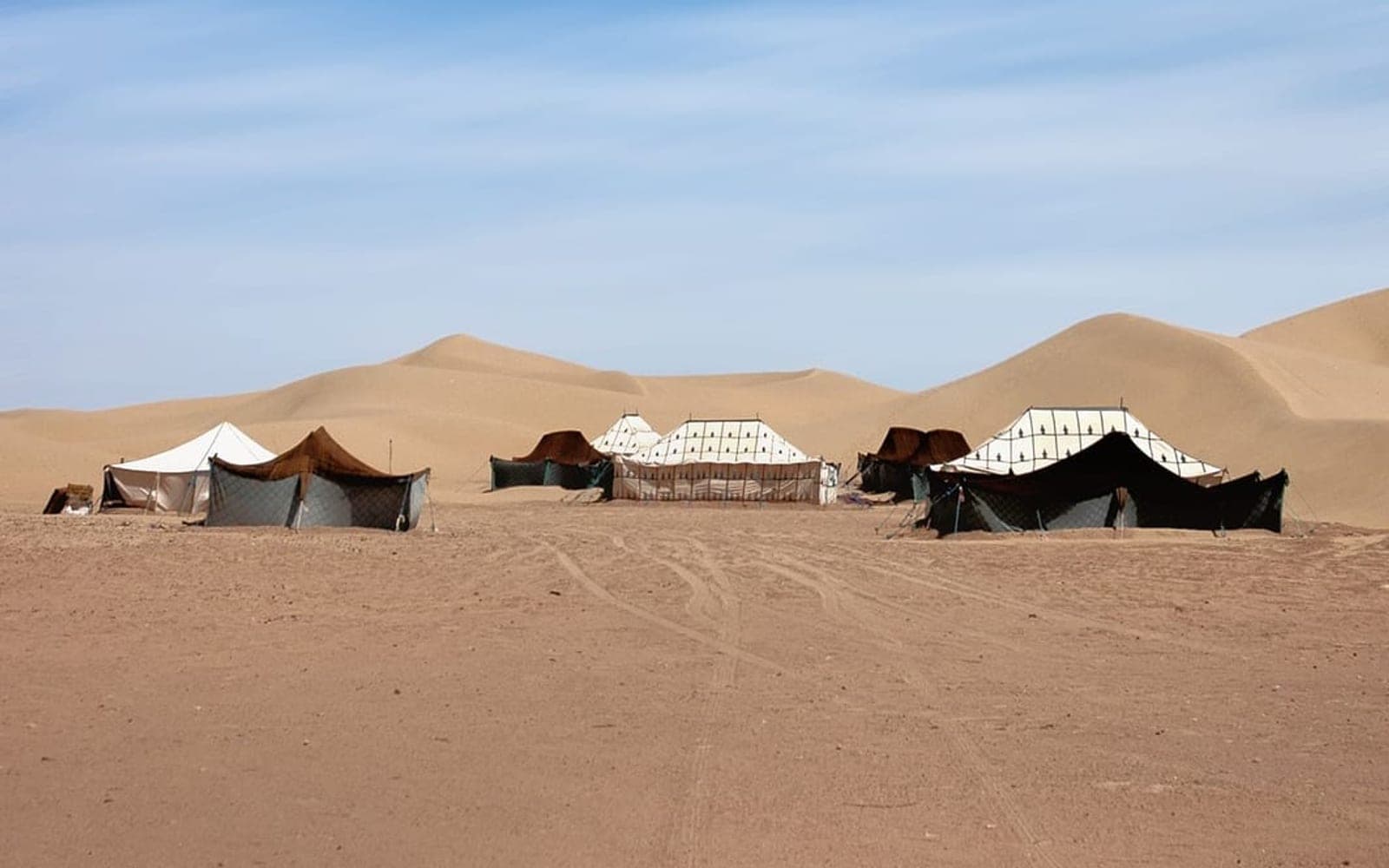
Erg Chegaga from Marrakech — 3-Day Remote Desert Expedition
- Erg Chegaga — fewer tourists, 120 m dunes, profound silence
- 4x4 off-road desert crossing from M'Hamid into the dune field
- A night in a desert camp with no other camps in sight
€281 / person for 5+
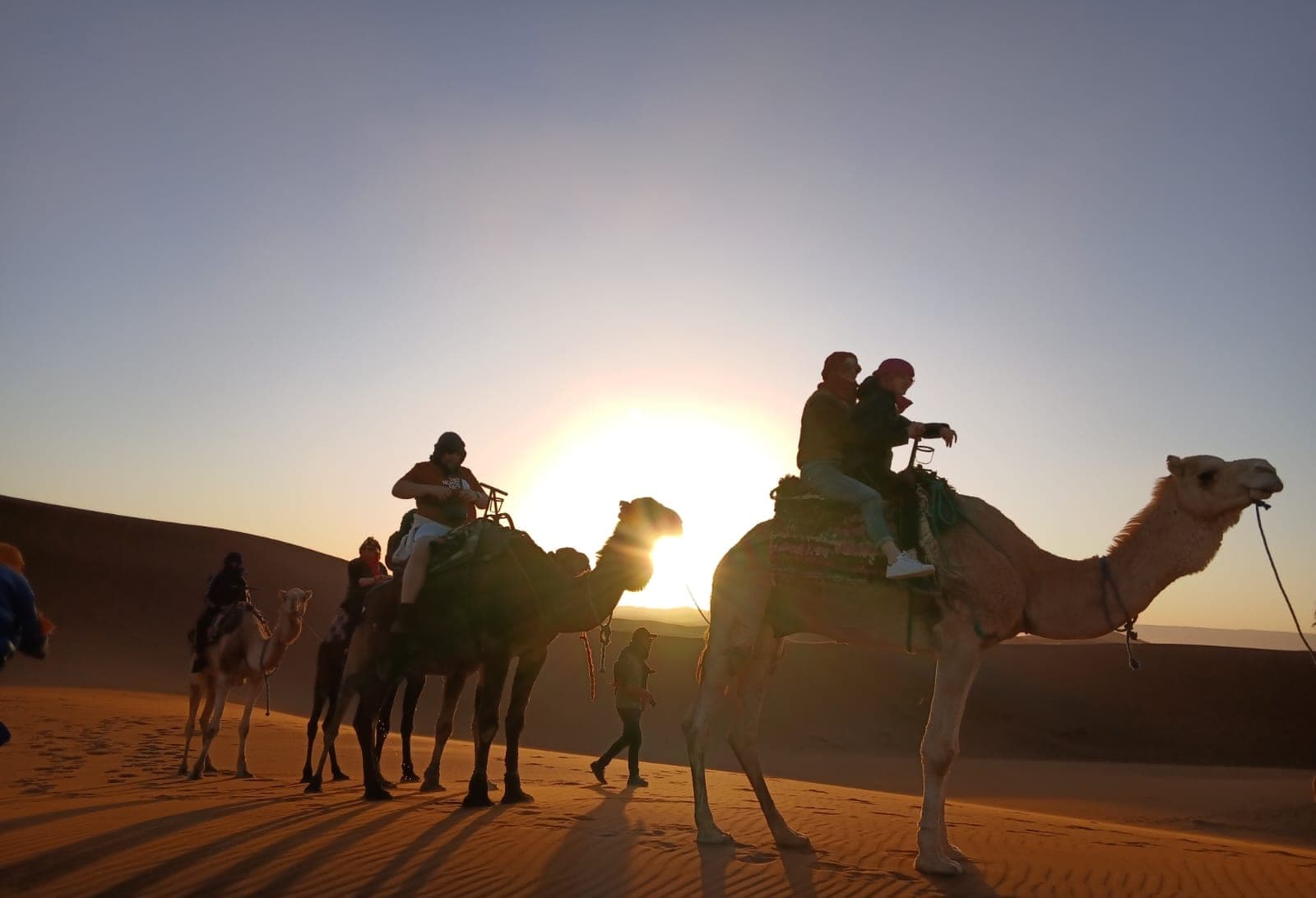
Merzouga Desert from Marrakech — 3-Day Shared Tour
- Tizi n'Tichka pass through the High Atlas
- UNESCO Ksar of Aït Ben Haddou
- Dades and Todra gorges
€120 / person
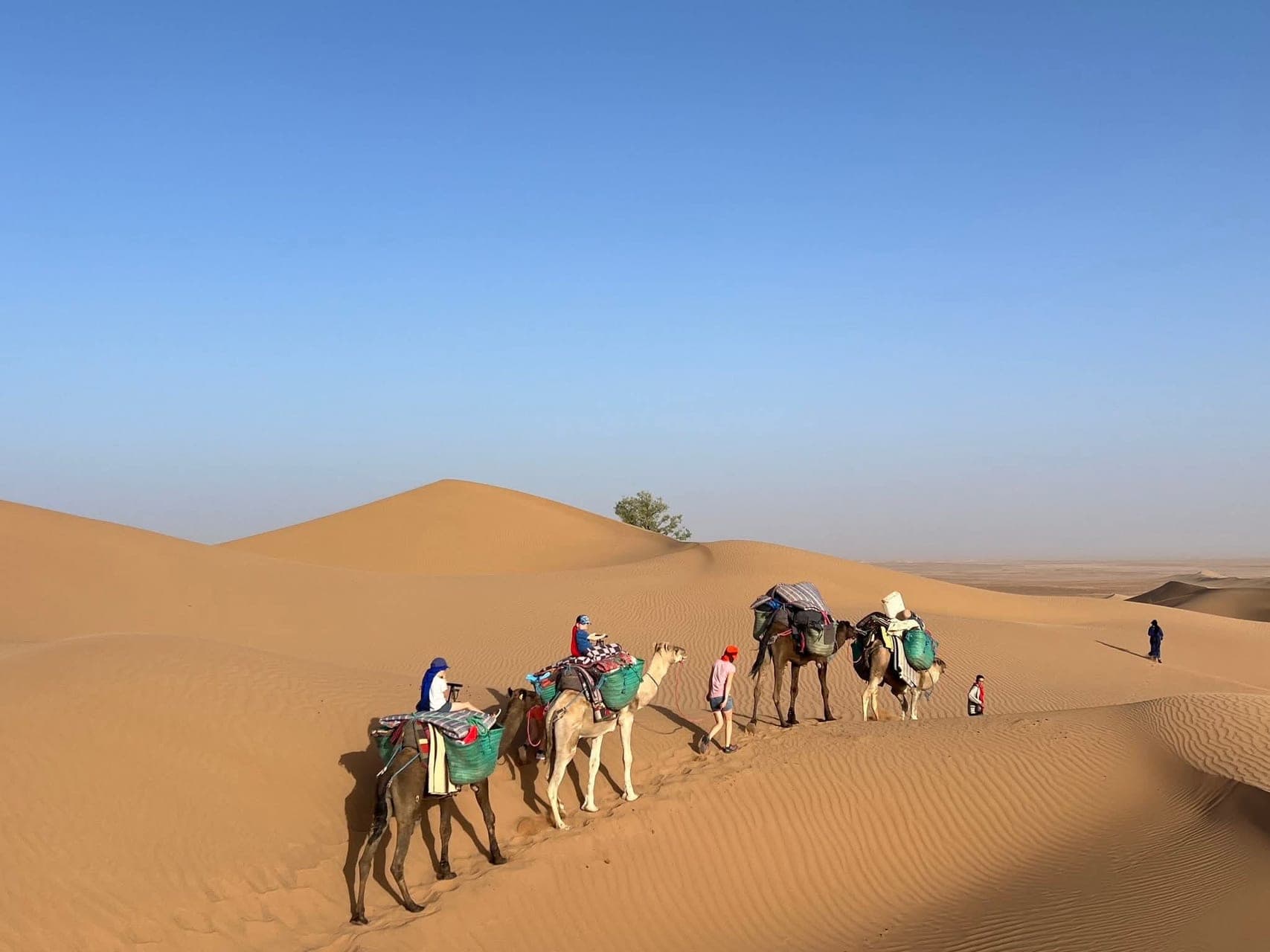
Family Desert Adventure — 4-Day Marrakech to Sahara
- A full night on the Erg Chebbi dunes in a family-friendly desert camp
- Camel rides and sandboarding on the dunes for the kids
- Explore the Aït Ben Haddou kasbah — a Game of Thrones and Gladiator film set
€229 / person for 14+