Rabat holds a UNESCO-listed medina, a 12th-century kasbah above the Atlantic, and a Roman-then-Merinid necropolis full of storks — and almost no crowds. Here is how to see it.
The Imperial City People Skip
Rabat is Morocco's capital, one of its four imperial cities, and the one most
visitors drive straight past on the way between Casablanca and Fes. That is
the reason to go.
Where Marrakech sells you something every thirty seconds and Fes can feel like
a test of nerve, Rabat is a working administrative city that happens to hold
nine centuries of architecture. Nobody follows you through the medina. The
kasbah is residential, not a stage set. You can stand at the Hassan Tower on a
Tuesday morning and have the esplanade largely to yourself.
The historic core has been a UNESCO World Heritage Site since 2012 — a
listing that covers both the old city and the French colonial town beside it,
which is unusual and tells you something about how Rabat is built in layers
rather than rings.
The Kasbah des Oudayas
This is the oldest and best part of the city, and it is free.
The kasbah sits on a bluff where the Bou Regreg river meets the Atlantic. Its
origins are Almoravid, but the fortress you walk into is essentially Almohad:
the 12th century is when it took its present shape, and the main mosque inside
dates from around 1150. The monumental gate, Bab Oudaia, is one of the finest
surviving pieces of Almohad military architecture anywhere — carved geometric
and vegetal stonework wrapped around an arch built to stop an army.
The blue-and-white lanes inside are the photograph everyone takes. They are
also somebody's street: the kasbah is lived in, so keep your voice down and
ask before photographing doorways.
Two things worth knowing:
The Andalusian Gardens are not Andalusian. They are beautiful — orange
trees, fountains, geometric paths inside ochre walls — but they were laid out
in the early 20th century, not by the Moriscos who resettled here in the
1600s. Most guides get this wrong. The Andalusian contribution to the kasbah
is real, it is just in the buildings rather than the flowerbeds.
Café Maure is worth the stop. It sits on the terrace above the river
mouth, mint tea is cheap, and the view across to Salé is the one that stays
with people.
Give the kasbah 1.5 to 3 hours. Free to enter, and you can wander it at any
reasonable hour.
Hassan Tower and the Mausoleum of Mohammed V
An unfinished minaret and a finished masterpiece, facing each other across a
field of broken columns.
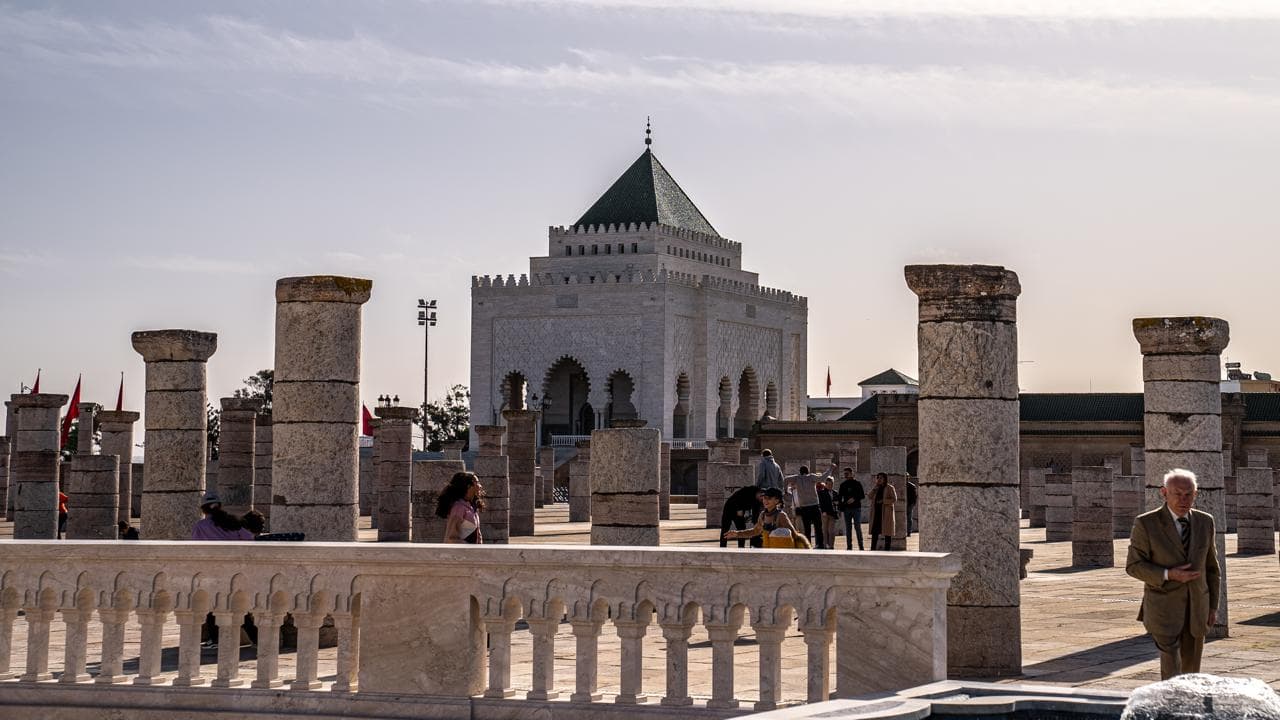
The tower was begun in 1195 and abandoned when the sultan died. It was meant
to be the largest minaret in the world, attached to the largest mosque; what
stands is 44 metres of the intended 86, surrounded by the stumps of 348
columns that never held a roof. An earthquake took the rest in 1755.
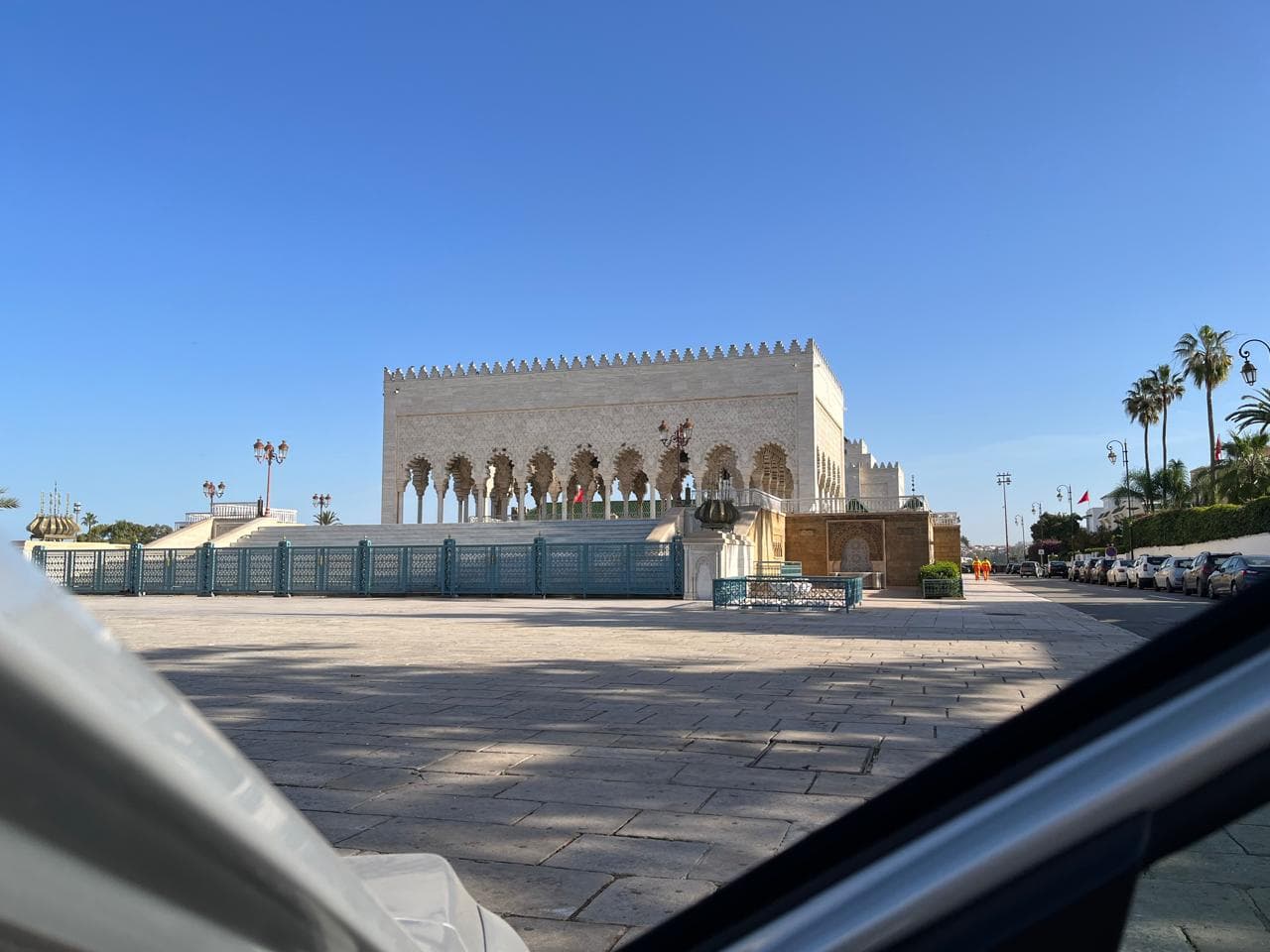
Opposite it, the Mausoleum of Mohammed V is the opposite proposition: 20th
century, finished to an extraordinary standard, and open to visitors. Carved
cedar, zellij tilework, an onyx sarcophagus under a dome. Royal guards stand
at the entrances in full dress and are used to being photographed.
Open daily 9am to 6pm. Free entry, both sites. Dress respectfully — this
is a working royal mausoleum, not a museum. Allow an hour.
The site is lit at night, and the walk past it after dark is one of the
better things you can do in Rabat for free.
The Chellah
The strangest place in the city, and the one people remember.
The Chellah is a walled necropolis built on top of a Roman town. The Romans
called it Sala Colonia and left a forum, a triumphal arch and a main street
you can still walk. The Merinids arrived in the 14th century, walled the whole
thing, and buried their sultans inside it — so you get Roman paving leading to
a Merinid minaret, with a mosque and a zaouia in between, all of it slowly
returning to the ground.
Storks nest on the ruins. In spring the noise of them is the defining sound of
the place, and the nests on top of the minaret are the photograph.
Entry is 70 DH, or 120 DH with an audioguide. Moroccans and foreign
residents pay half. Allow 1.5 hours, and go late in the afternoon when the
light is low and the storks are active.
The Medina and the Rest
Rabat's medina is small, tidy, and refreshingly free of hard selling. It is a
place to buy something you actually want rather than something you have been
talked into. Rue des Consuls is the main craft street.
If you have a second day: the Mohammed VI Museum of Modern and Contemporary
Art is genuinely good and the only museum of its kind in the country, and the
rowboat crossing of the Bou Regreg to Salé costs a few dirhams and takes five
minutes.
How Long Rabat Needs
One full day covers the three big sites — kasbah in the morning, Hassan
Tower before lunch, Chellah in the late afternoon. That is the standard
imperial-cities itinerary and it works.
Two days adds the medina, the museum, Salé, and the time to sit still,
which is the thing Rabat is actually good for.
Most tours give it a day, and for a first visit that is honest rather than
mean. The city rewards a slow morning more than a long list.
When to Come
Spring (March to May) and autumn (September to November) are the best months:
mild, clear, and the storks are at the Chellah in spring. Rabat is Atlantic
rather than Saharan, so summers are far softer than Marrakech and winters are
grey and wet rather than cold. There is no bad month, only wetter ones.
Getting There
Rabat sits on the main line between Casablanca and Tangier, and the train is
genuinely good — roughly an hour from Casablanca, around four and a half from
Marrakech. The station is central.
If you are travelling the imperial cities as a circuit, Rabat usually falls
between Casablanca and Meknes, which is the natural geographic order and the
one our routes follow. Our
5-day imperial cities tour from Marrakech
covers Rabat, Meknes and Fes with the driving handled and entry fees included,
and the
6-day version from Agadir does the
same from the coast. For the practical alternatives, our
guide to getting around Morocco
compares trains, buses and private transfers by route.
Trips that go here
Guided by the team who wrote this guide.
Marrakech — All 4 Imperial Cities — 5-Day Grand Tour
- All 4 Imperial Cities: Marrakech, Meknes, Fes, Rabat
- Volubilis Roman ruins (UNESCO World Heritage)
- Hassan II Mosque in Rabat
€261 / person for 6+
Agadir — All 4 Imperial Cities — 6-Day Grand Tour
- All 4 Imperial Cities: Marrakech, Meknes, Fes, Rabat
- Volubilis Roman ruins (UNESCO World Heritage)
- Hassan II Mosque in Rabat
€303 / person for 6+
Casablanca to Marrakech — 5-Day Imperial Cities & Sahara
- Hassan Tower and the Kasbah of the Udayas in Rabat
- Volubilis — Roman mosaics still in the ground where they were laid
- Bab Mansour and the imperial granaries at Meknes
€470 / person for 6+