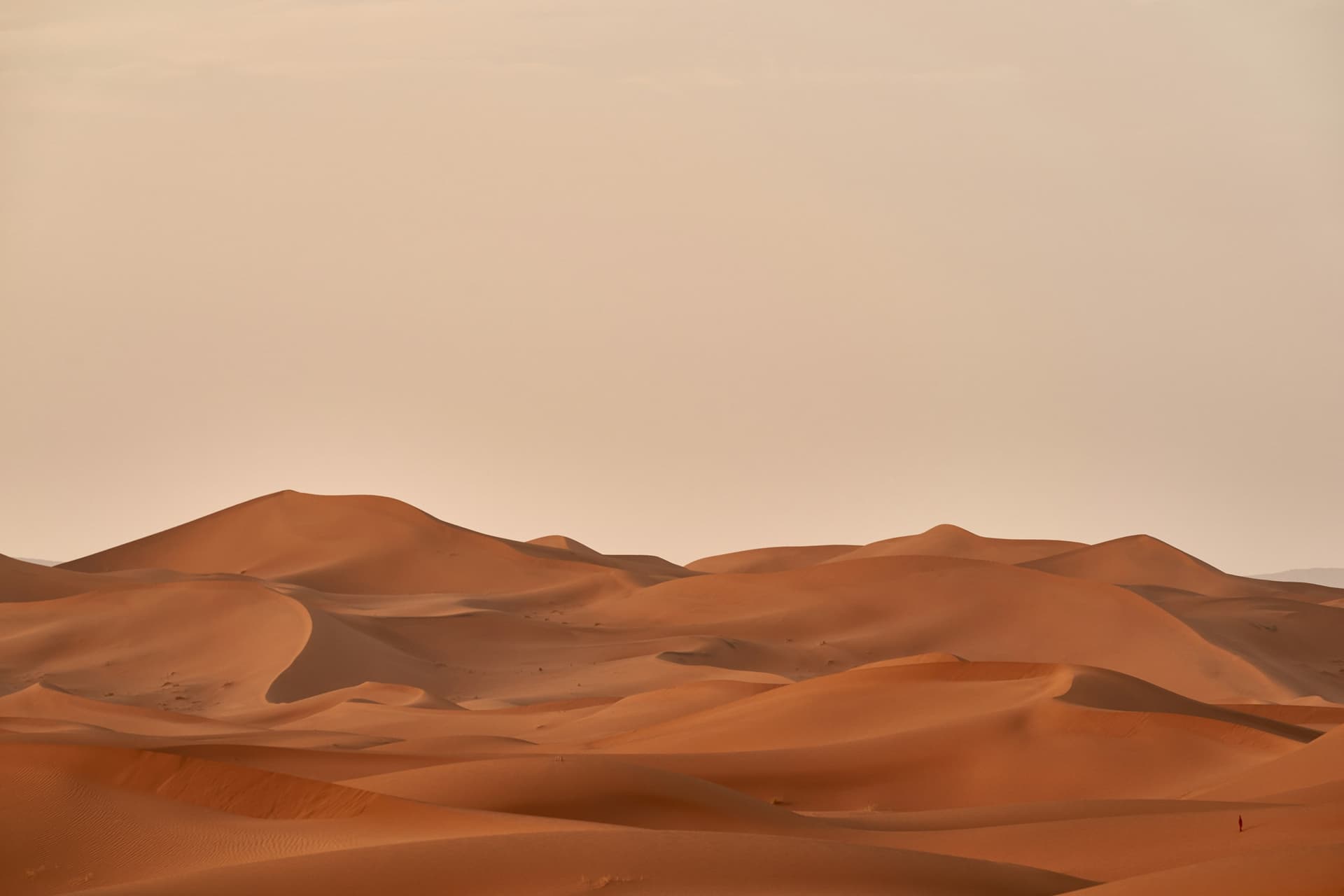
The Sahara is bigger, older and less empty than most people picture. Here are the real numbers behind the desert you're about to visit — and a few common claims that don't hold up.
Bigger Than You're Picturing
The Sahara covers about 9.2 million square kilometres — close to the size of the entire United States, and larger than the whole of Europe. It's the largest hot desert on Earth (only the cold deserts of Antarctica and the Arctic are bigger) and stretches across roughly a dozen countries, from Morocco and Mauritania on the Atlantic coast to Egypt and Sudan on the Red Sea. What you'll see from Merzouga or Zagora is a genuine edge of something vastly larger than the two or three days you spend in it.
Most of It Isn't Dunes
This is the fact that surprises people most: sand dunes (erg, in the Arabic-derived term used across the region) make up a minority of the Sahara's surface. Most of the desert is either reg — flat, stony gravel plain — or hamada, bare rocky plateau. The tall, photogenic dune seas most people picture when they hear "Sahara" are specific, relatively contained regions within the larger desert. Erg Chebbi, near Merzouga, and Erg Chegaga, further south and harder to reach, are Morocco's two accessible examples — and both are genuinely the real thing, not a scaled-down imitation for tourists.
How Tall Are the Dunes, Actually?
At Erg Chebbi, the tallest dunes reach roughly 150 metres — genuinely large, and enough to disorient your sense of scale once you're walking on them. Some dune systems elsewhere in the Sahara (notably in Algeria's Grand Erg Oriental) reach considerably higher, but Erg Chebbi's dunes are tall enough that the classic sunrise-from-the-top photograph is not an exaggeration; it's a real, if slightly strenuous, climb.
It Wasn't Always Desert
For a long stretch of the African Humid Period, roughly 11,000 to 5,000 years ago, much of what's now the Sahara was savanna and lakes, with evidence of human settlement, cattle herding and rock art depicting animals that couldn't survive there today. The shift to the current arid climate happened over centuries, not overnight, driven by changes in the Earth's orbital cycle. The desert you're visiting is, in that sense, geologically recent.
Less Empty Than It Looks
"Empty" is the word most first-time visitors reach for, and it's not accurate. The Sahara supports roughly 70 mammal species, around 90 bird species, and about 100 reptile species — most of them nocturnal or otherwise built to avoid the worst of the daytime heat, which is exactly why a desert camp can feel completely still at 2pm and genuinely alive after dark. The fennec fox, the smallest canid species on earth, is the most recognisable — oversized ears that radiate heat away, a pale coat that reflects sun rather than absorbing it, and burrows it rarely leaves before evening. Jerboas, small hopping desert rodents, are a common night sighting around Erg Chebbi's dune edges. Scorpions are real and present, including species capable of a genuinely dangerous sting, which is the actual, practical reason guides tell you to shake out shoes before putting them on at a desert camp — not superstition, a real precaution for a real risk that's nonetheless easy to manage with basic care.
Is It Growing?
There's real evidence the Sahara has expanded over roughly the last century, though the causes are debated between natural multi-decade climate cycles and broader climate change, and the picture at the desert's southern edge (the Sahel) is more mixed than a simple one-directional trend. It's an active research question, not a settled fact — worth knowing if a guide or article states it too confidently in either direction.
Seeing It Properly
Numbers on a page don't really convey what a dune sea feels like at dawn. For that, see our 3-day Marrakech to the Sahara tour, or if you're comparing which desert region suits your trip, Agafay vs Merzouga vs Zagora.
Frequently asked questions
How big is the Sahara, really?
Are the dunes at Merzouga the 'real' Sahara?
Is the Sahara growing?
Trips that go here
Guided by the team who wrote this guide.
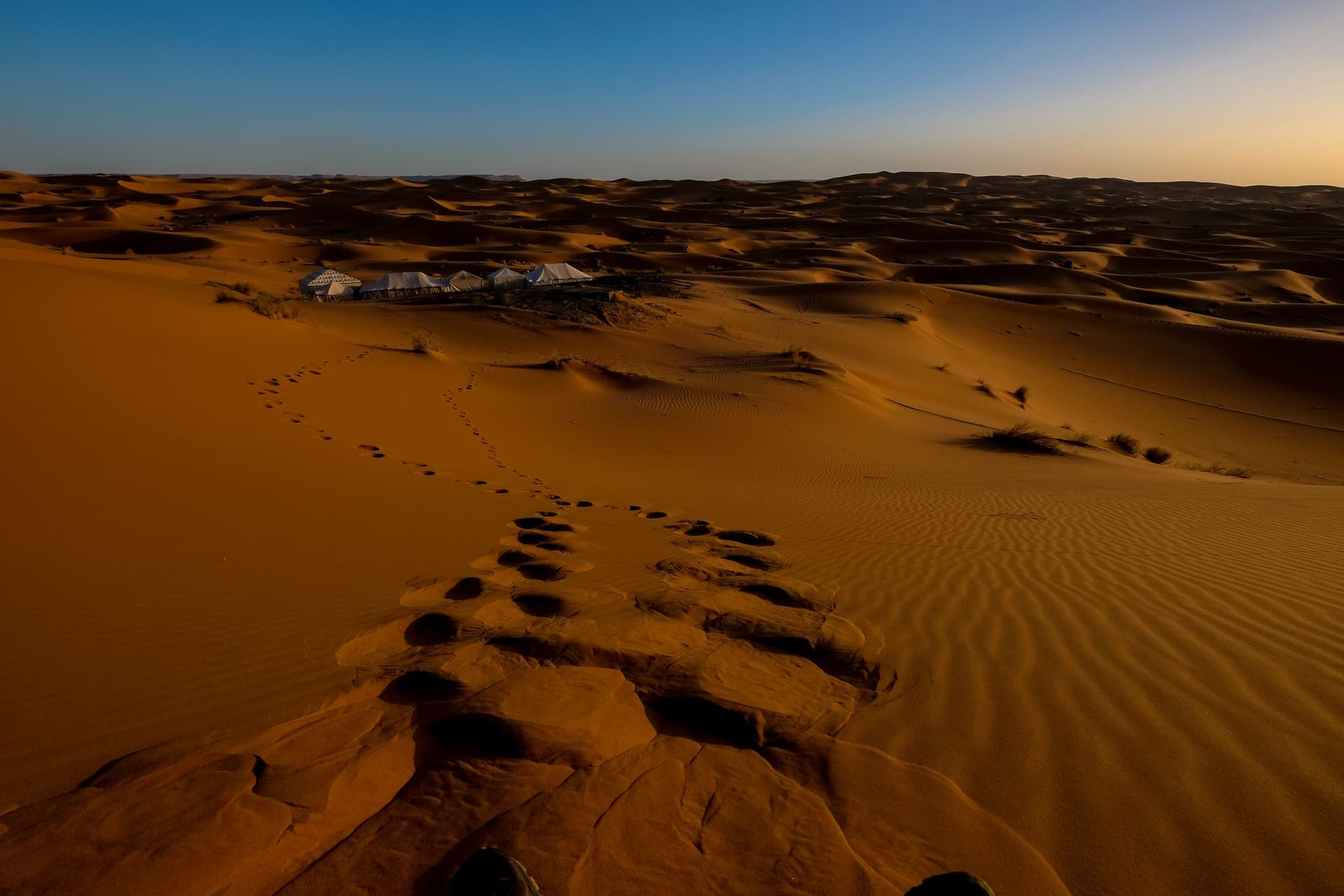
Marrakech to Merzouga — 3-Day Desert Tour
- Camel trek into Erg Chebbi dunes at sunset
- Overnight in a luxury Berber desert camp
- Stargazing with no light pollution at all
€230 / person for 6+
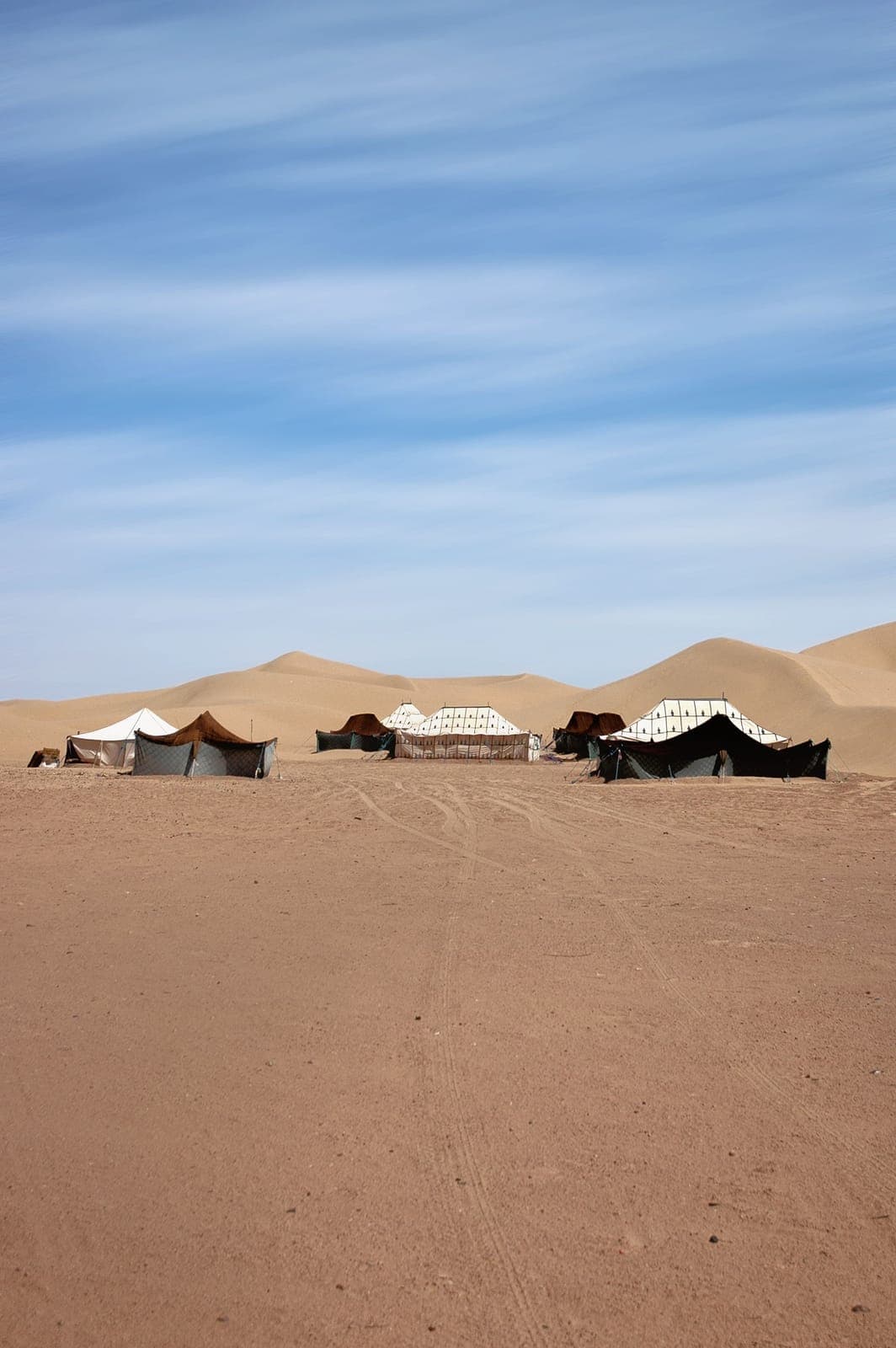
Erg Chegaga from Marrakech — 3-Day Remote Desert Expedition
- Erg Chegaga — fewer tourists, 120 m dunes, profound silence
- 4x4 off-road desert crossing from M'Hamid into the dune field
- A night in a desert camp with no other camps in sight
€281 / person for 5+