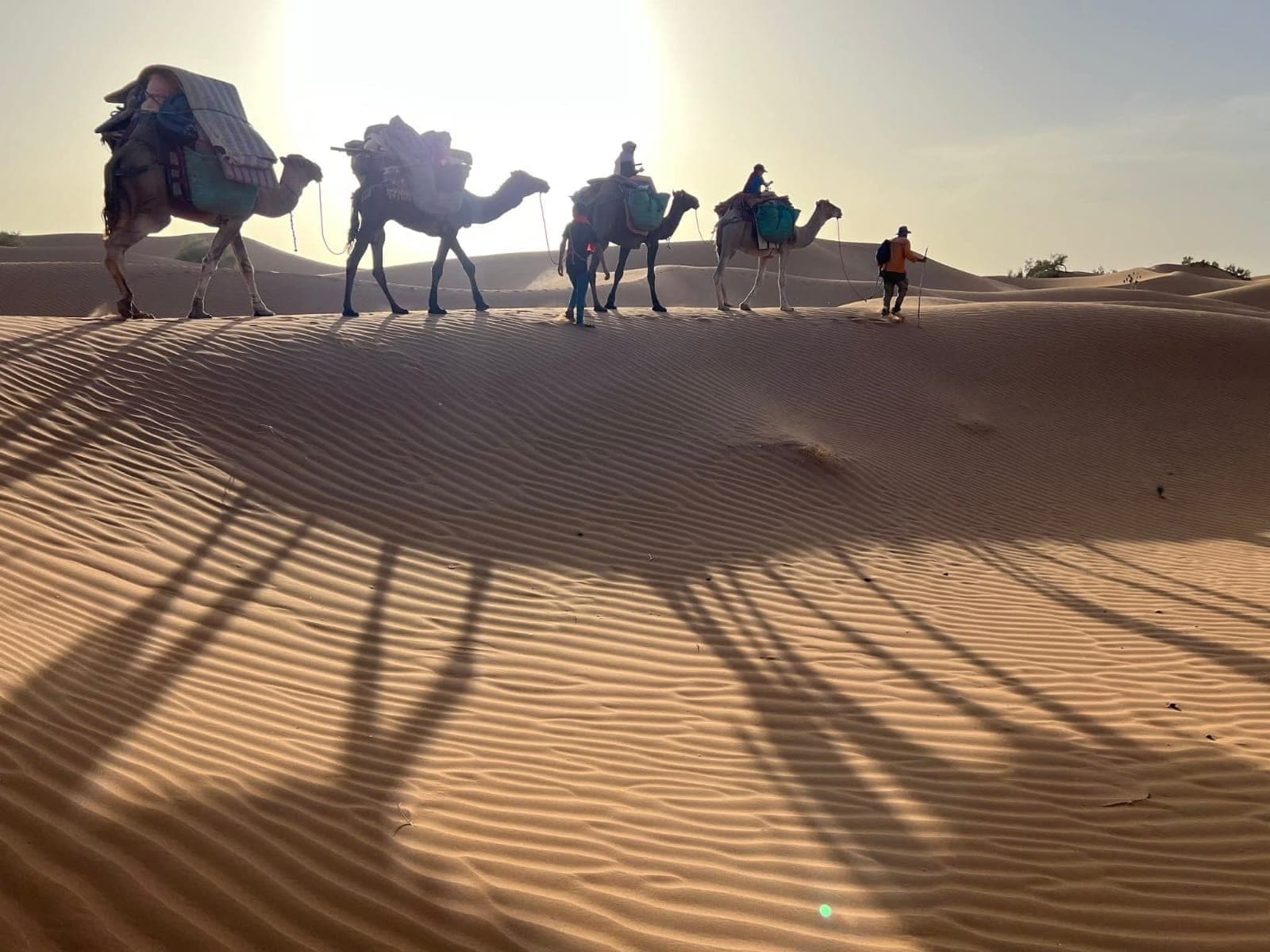
Most Morocco camel treks are a ninety-minute ride into the dunes at sunset. A real caravan trek is something else: you walk, the camels carry the camp, and you cover about 17 km a day. Here is the difference, and the welfare question nobody puts on a booking page.
Two different things share one name
Search "Morocco camel trek" and you will get two products described in nearly
identical language.
The first is a sunset ride: an hour, maybe ninety minutes, from a car park
at the edge of the dunes to a fixed camp. You sit on a saddled dromedary in a
line of ten, a handler leads, and you arrive in time for dinner and drumming.
It is genuinely lovely, and it is what most people mean by a camel trek. It is
included in our 3-day Sahara tour.
The second is a caravan trek, and it barely resembles the first. The camels
carry the camp — tents, water, food, cooking kit. You walk. Days are five to
seven hours on foot, you sleep wherever the caravan stops, and there is no road
and no fixed camp for the duration.
Both are worth doing. Booking one expecting the other is the mistake, and the
booking pages rarely make the difference obvious.
What the walking actually involves
Our 8-day Chegaga trek covers roughly
83 km on foot across five trekking days — a little under 17 km a day. The
route runs Draa Valley → the Hamada du Draa → over the Abbes pass into **Erg
Chegaga** → the Bougarne dunes → Oued Naam → out at M'hamid.
Seventeen kilometres sounds light. In sand, at desert pace, it is a working
day. The ground is flat, there is no altitude and nothing technical, so the
difficulty is repetition rather than any one hard section — six consecutive
days of the same effort, with the sun and the surface doing the wearing.
The pace is set by the caravan, not by you, and it is slower than you would
walk alone. That is deliberate: the camels set a rhythm the whole group can
hold for a week.
Do you ride at all?
Some, usually briefly, and less than you are imagining.
The camels are load animals on this kind of trip. Their work is carrying the
camp; a rider is extra weight on an animal already carrying a week of water and
equipment. In practice people ride a little — crossing a stretch of open
hamada, or when a blister needs an hour off — and walk the rest.
This is not a limitation we apologise for. **It is the ethical structure of the
trip**, and it is worth explaining why.
The welfare question
This deserves a straight answer rather than a paragraph of reassurance.
Morocco has no national animal welfare law. PETA's investigations at
Moroccan tourist ride sites documented camels beaten, tethered on ropes a few
feet long without shade in extreme heat, and sold for slaughter once they stop
being profitable — often after around five years of ride work. That reporting
is real and it is about a real part of this industry.
It does not describe every operation, and the difference is not a matter of
branding. It is structural, and you can check it with direct questions:
- Who owns the camels? Animals owned by the nomad families who work them
are cared for differently from animals owned by a ride concession that rents
them out by the hour.
- Do the camels carry people or equipment? Pack work spread across a
caravan is a fundamentally lighter load than continuous rider rotation.
- How many camels per traveller? More animals means less weight each.
- What happens between departures? Rest and natural grazing, or tethered at
a ride site waiting for the next group.
- What happens when a camel is too old to work? The honest answer in a good
operation is retirement at sixteen to eighteen, not the meat market.
Ask those five questions of any operator, ours included. The ones doing it
properly answer immediately and specifically, because the answers are simply
how they already work. Vagueness is the signal.
Our caravan camels belong to the M'hamid families who walk them, they carry
equipment rather than passengers, and they rest between departures. That is
also precisely why you walk.
What it is like to sleep out there
There is no fixed camp on this route. The bivouac moves with you and is pitched
where the day ends.
The practical consequences: no plumbing, no generator, no wifi, and — past the
Chegaga dunes — no artificial light within about 50 km. The night sky is the
part people describe afterwards, and it is a straightforward function of that
distance from anything electrical.
Desert nights are cold. Winter lows around Chegaga sit close to freezing,
and the temperature swing between afternoon and 3 am is the thing most first-
timers underestimate. A real sleeping bag matters more than any other item you
pack — see what to pack for a desert tour.
When to go
October to April. Outside that window the midday heat in the Draa makes a
walking caravan unsafe rather than merely unpleasant, and reputable operators
stop running them.
Within it:
- October–November: warm days, mild nights. The easiest introduction.
- December–February: clear, cold, excellent walking. Bring the sleeping bag.
- March–April: warming, longer days, and the last comfortable window before
the season closes.
Chegaga or Chebbi?
Caravan treks work at Erg Chegaga in a way they do not at Erg Chebbi, and the
reason is access. Chebbi is reached by a sealed road from Merzouga, which is
what makes the fixed camps and short rides there possible. Chegaga is 50-odd km
from the nearest tarmac, which rules out the day-trip model and leaves the
caravan as the honest way in.
That is the whole trade-off: Chebbi is easier to reach and busier; Chegaga
takes days and is empty. We compare them in detail in
Who this suits
A caravan trek is right for you if you want a walking route with a desert as
the terrain, you are comfortable being genuinely off-grid for the better part
of a week, and the idea of no shower for six days reads as part of the appeal
rather than a cost.
It is the wrong trip if what you actually want is dunes at sunset, a good
dinner and a bed. That trip exists, we run it, and it is not a lesser
experience — it is a different one. Book the one you want.
👉 See the 8-day Chegaga camel trek — 83 km on foot through the Draa and Erg Chegaga, moving bivouac, camels owned and walked by the M'hamid families who work them.
Frequently asked questions
Do you ride the camel the whole way on a multi-day trek?
How far do you actually cover on a Sahara caravan trek?
Is camel trekking in Morocco ethical?
How fit do you need to be?
When is the best time for a camel trek?
Where do you sleep on a caravan trek?
Trips that go here
Guided by the team who wrote this guide.
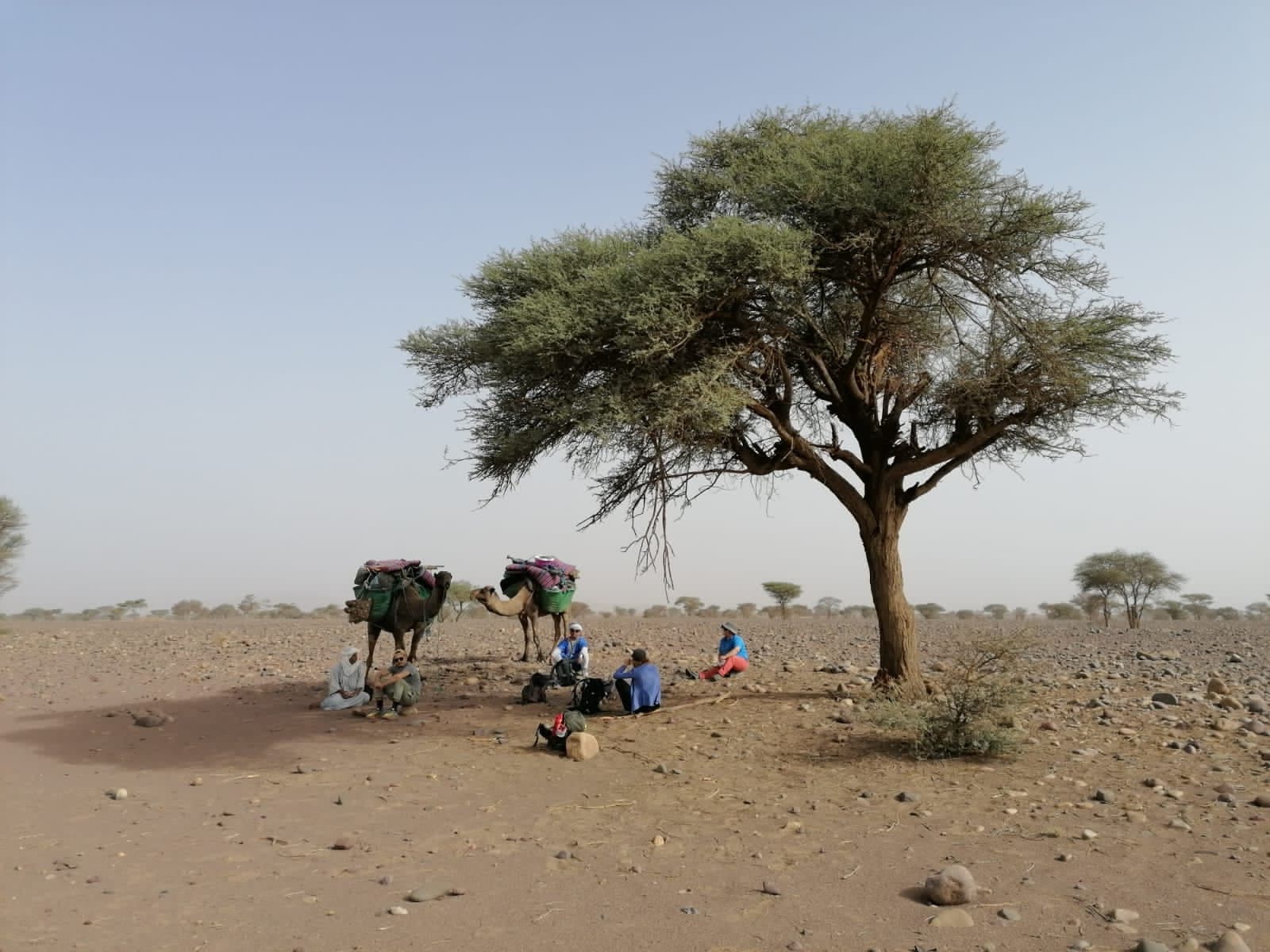
Draa Valley to M'hamid — 8-Day Chegaga Camel Trek
- Six days walking with a camel caravan — not a one-hour ride
- Erg Chegaga: 50 km of dunes, reached on foot rather than by 4x4
- A different wild camp every night, with no fixed site and no other groups
€765 / person for 5+
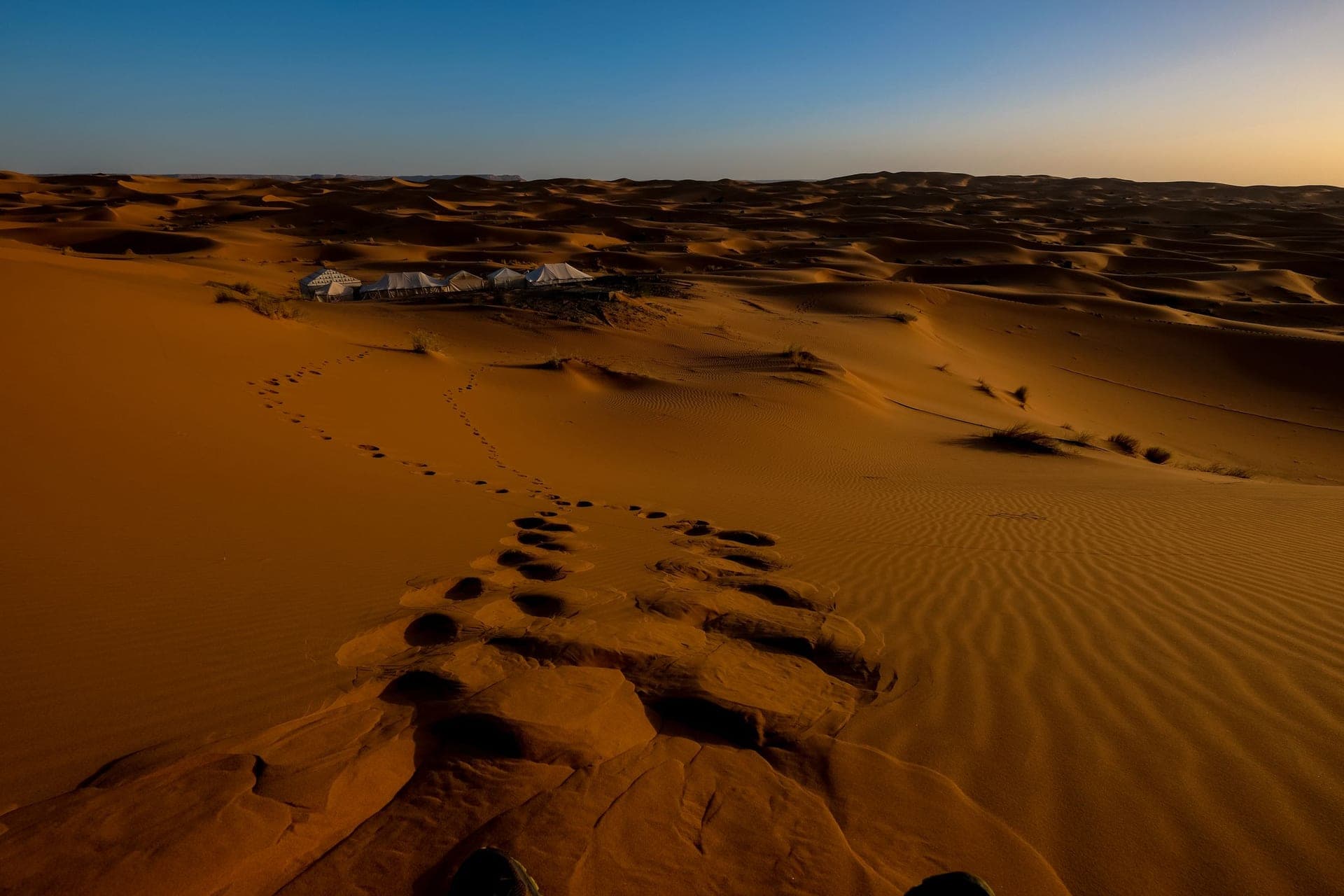
Marrakech to Merzouga — 3-Day Desert Tour
- Camel trek into Erg Chebbi dunes at sunset
- Overnight in a luxury Berber desert camp
- Stargazing with no light pollution at all
€230 / person for 6+
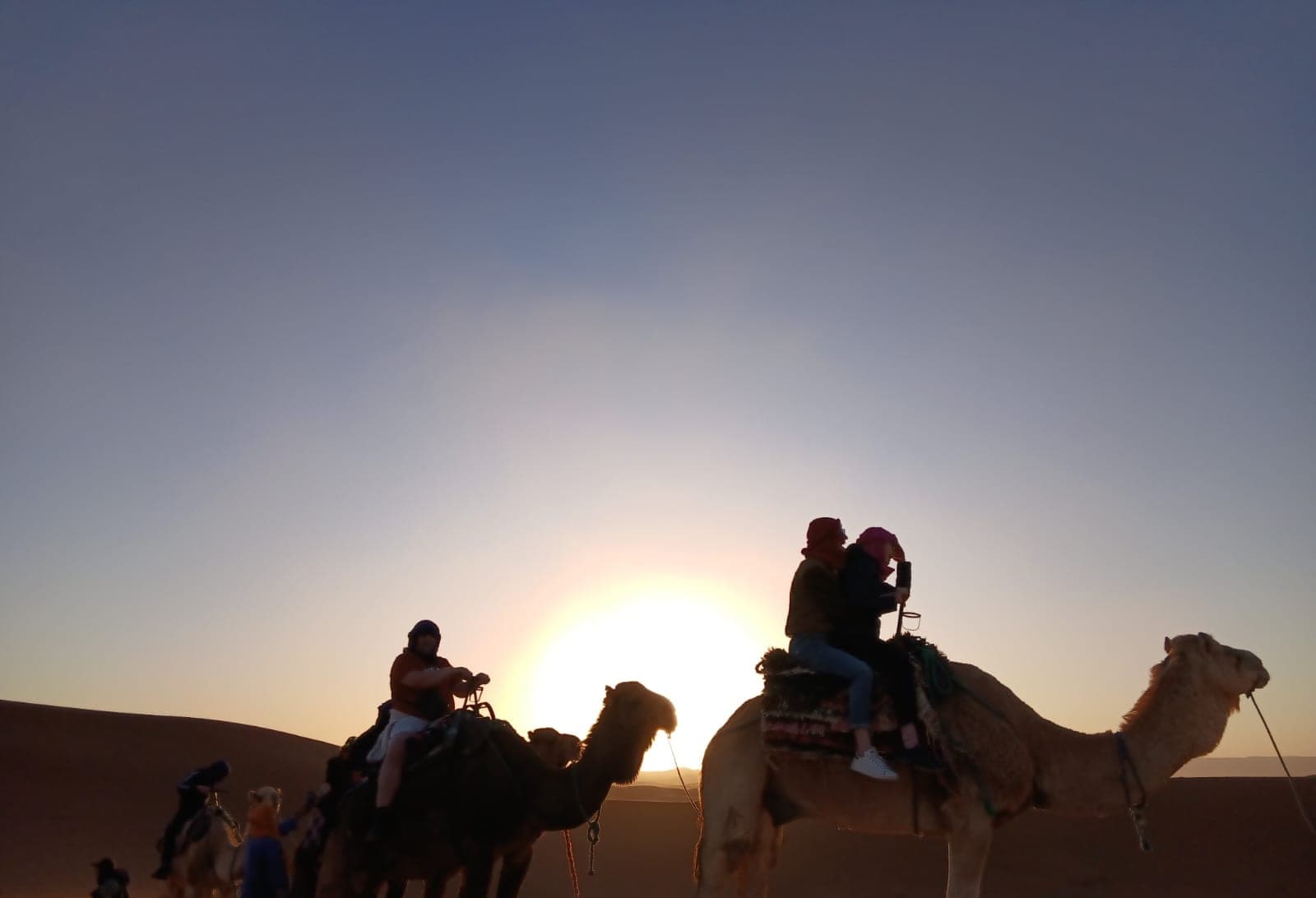
Merzouga Stargazing from Marrakech — 2-Day Dark Sky Desert Tour
- Guided naked-eye and telescope stargazing session with an astronomy guide
- Sunset camel trek into the Erg Chebbi dunes
- One night in a traditional Berber desert camp, far from any light pollution
€121 / person for 6+