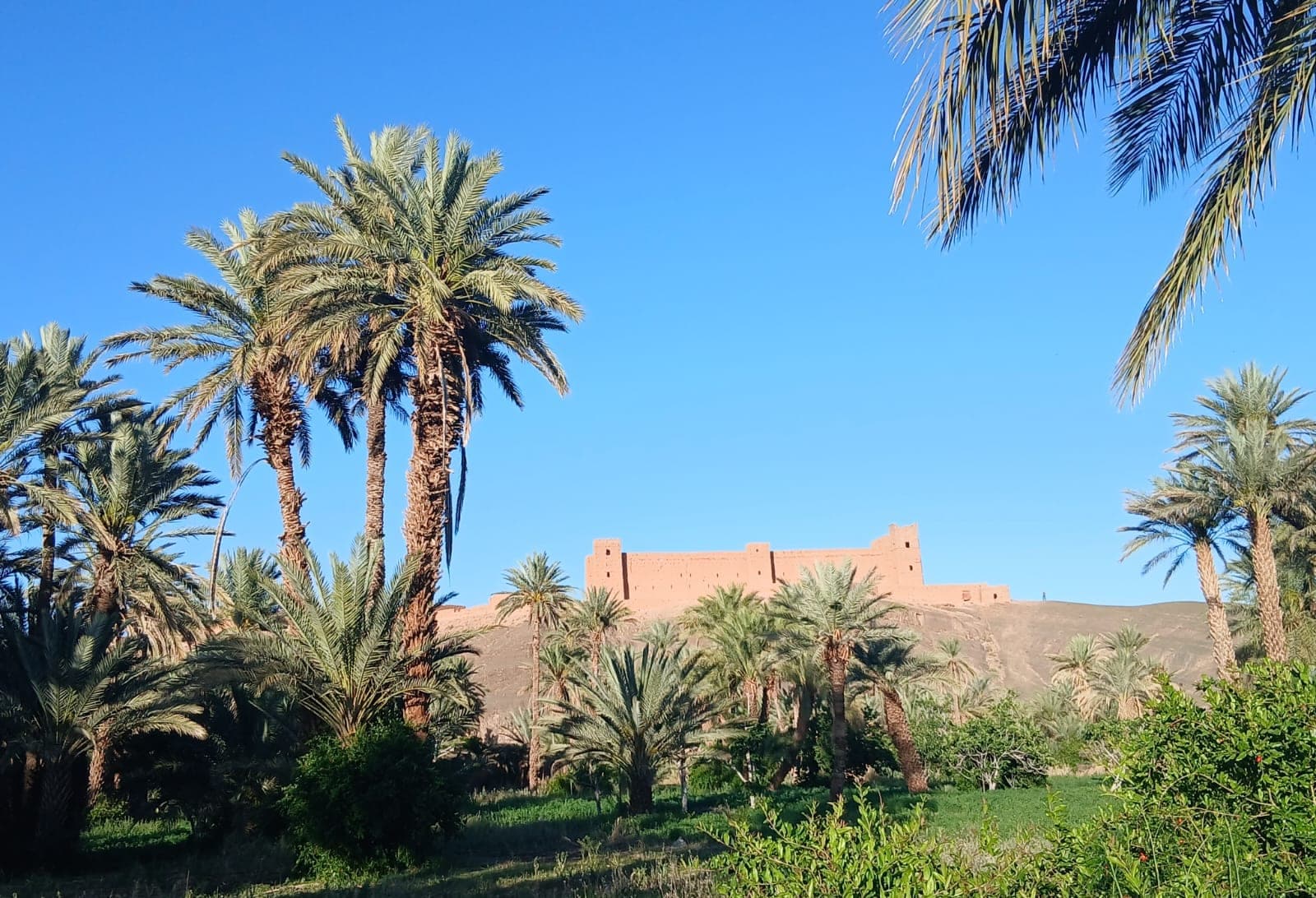
Kasbah gets used loosely in English to mean 'exotic old building.' Here is what it actually means, and how it differs from a riad, a ksar and a medina.
Not Just "Old Fort" — A Specific Kind of Building
In English travel writing, "kasbah" often gets used loosely to mean any exotic-looking old building in Morocco. The real meaning is more specific: a kasbah is a fortified residence, traditionally built for a local chief, governor or powerful family, with defensive walls and square corner towers. It's a single structure, not a village — the confusion comes because many kasbahs anchored settlements that grew up around them, and the word gets applied loosely to the whole place.
The word itself comes from the Arabic *qaṣaba*, meaning fortress or citadel — historically a flexible term that could mean anything from a single fortified building to the administrative heart of a wider settlement. In Morocco specifically, it settled into meaning the fortified home of a *caïd* — a local chief or governor who held real administrative and military authority over the surrounding territory, not just a wealthy landowner. A kasbah wasn't a status symbol first; it was the physical seat of actual regional power, built to defend it.
Kasbah vs Ksar
The word you actually want for a whole fortified village is ksar (plural ksour) — a cluster of kasbah-style buildings enclosed by a shared outer wall, built collectively rather than as one family's residence. Ait Benhaddou is the best-known example, and it's technically a ksar, though "the kasbah of Ait Benhaddou" is the phrase you'll hear used interchangeably in practice, including by guides.
Telouet: What Kasbah Power Actually Looked Like
If you want to see what "fortified seat of a caïd's power" meant in practice, rather than just architecture, the kasbah at Telouet is the place to understand it. Built from 1860 onward and expanded for decades after, it was the stronghold of the Glaoui family, who used control of the Tizi n'Tichka pass — the main route between Marrakech and the Sahara — to tax the caravan trade moving through it and accumulate serious regional power. Under French colonial rule after 1912, the family allied with the protectorate, and Thami El Glaoui, head of the family, was installed as Pasha of Marrakesh. At the height of his influence he was one of the wealthiest and most powerful men in the country — a local caïd's fortress turned into the base for something closer to a private kingdom. The kasbah itself, now partially ruined, still shows the scale of that ambition in its size and its lavishly decorated reception rooms, a level of interior craftsmanship well beyond what a purely defensive building would need.
That history is worth knowing because it explains why kasbahs cluster so densely along certain routes and not others: they mark the passes and river valleys that were actually worth controlling, not scenic spots chosen at random.
What They're Built From
Almost all traditional kasbahs and ksour share the same building material: pisé, or rammed earth, made from clay, sand and straw compacted into thick walls, sometimes reinforced with palm-wood beams. This is why the whole region has that consistent reddish-ochre colour — the buildings are quite literally made from the ground they stand on. The material is well suited to the climate (thick earthen walls buffer against extreme daytime heat and cold desert nights) but needs regular re-plastering to survive; abandoned kasbahs erode back into the landscape within decades without upkeep.
Defensive design details are consistent across almost every kasbah worth visiting: a single gated entrance rather than multiple access points, few and small exterior windows (easy to defend, hard to breach), and square corner towers giving sightlines along every wall. None of it is decorative — every element served the building's original purpose.
Where to See the Best Examples
The kasbah road runs east from Marrakech over the Tizi n'Tichka pass toward Ouarzazate — sometimes called Morocco's "Hollywood of the desert" for its film studios — and on toward the Dades and Todra valleys, where the concentration of kasbahs is so dense the route has its own nickname, the Road of a Thousand Kasbahs. Ait Benhaddou and Kasbah Amridil in Skoura are the two most complete and accessible examples on that route, and Telouet itself is a worthwhile detour off the Tizi n'Tichka road for anyone specifically interested in the history behind the architecture rather than just the photographs.
That road is not a day trip from Marrakech — Ait Benhaddou alone is four hours each way, and the kasbahs worth seeing are strung along the next 200 km. Our 4-day desert route from Marrakech follows it properly, stopping at Ait Benhaddou and Skoura on the way to the dunes instead of turning back at the first one.
For Sleeping, Not Just Looking
Some restored kasbahs now operate as guesthouses, giving you a night inside the thick earthen walls rather than just a photo stop. This is different from staying in a riad, which is a courtyard house built for city life, not defence — see What Is a Riad? for that distinction.
Frequently asked questions
What's the difference between a kasbah and a ksar?
Is a kasbah the same as a riad?
Why are so many kasbahs made of the same reddish clay?
Trips that go here
Guided by the team who wrote this guide.
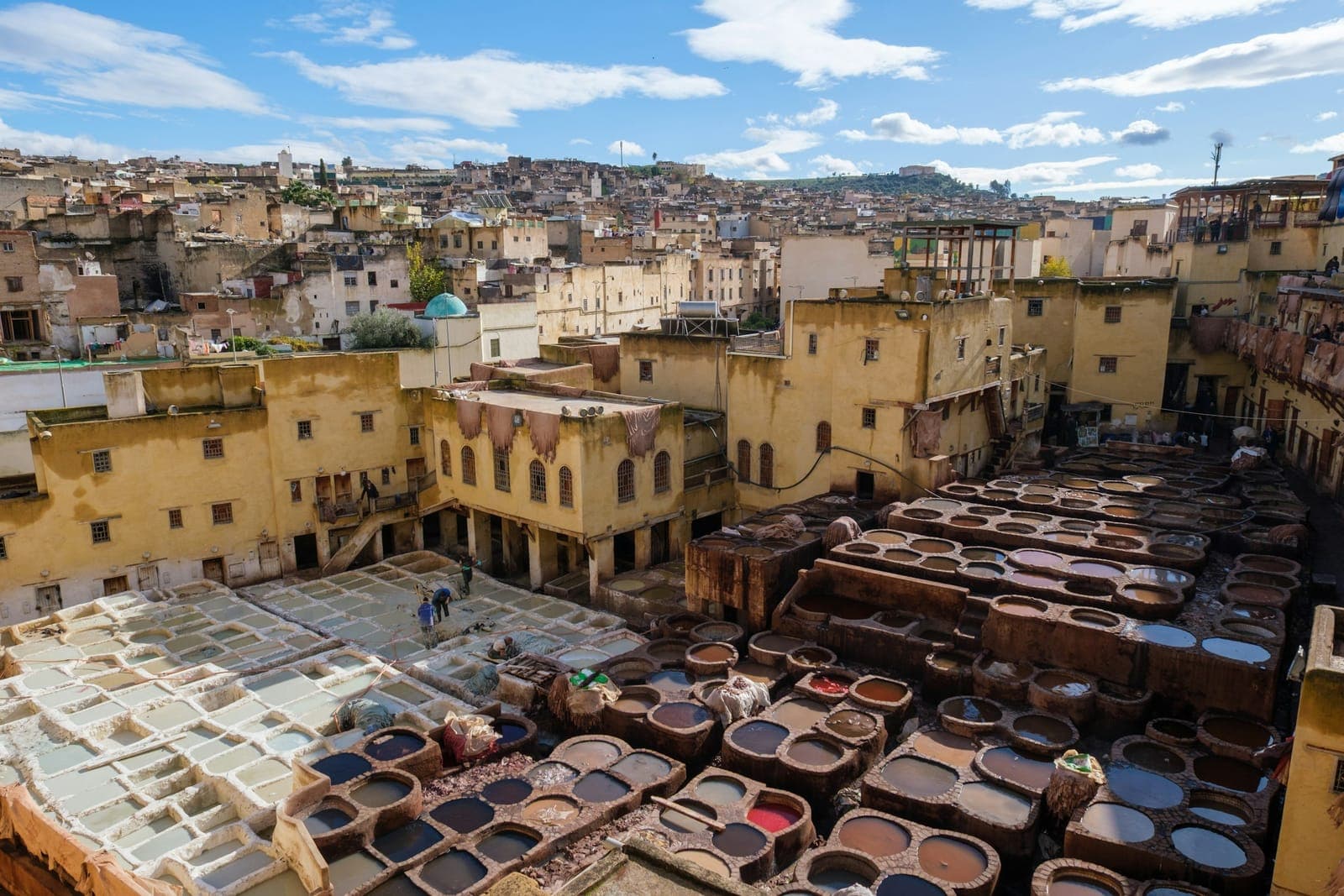
Marrakech to Fes — 3-Day Imperial Cities Tour
- Tizi n'Tichka mountain pass (2,260 m)
- Aït Ben Haddou UNESCO World Heritage Ksar
- Ifrane — Morocco's Alpine village
€299 / person for 14+
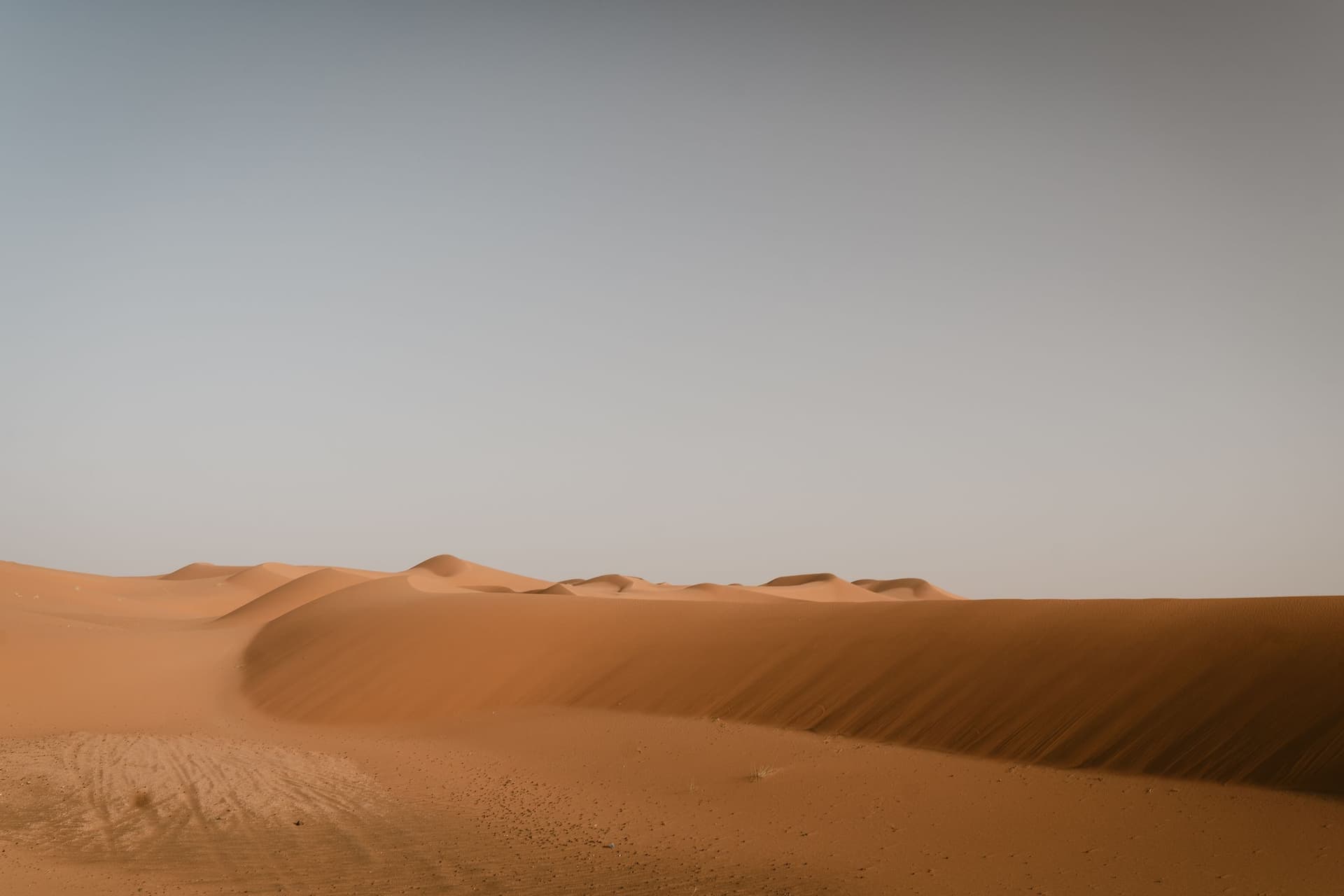
Marrakech Desert Grand Tour — 4 Days
- Full night at an Erg Chebbi desert camp — sunset and sunrise camel treks
- Todra Gorge — Morocco's most dramatic canyon (400 m walls, 4 km walk)
- UNESCO Ksar of Aït Ben Haddou — Gladiator and Game of Thrones location
€236 / person for 6+