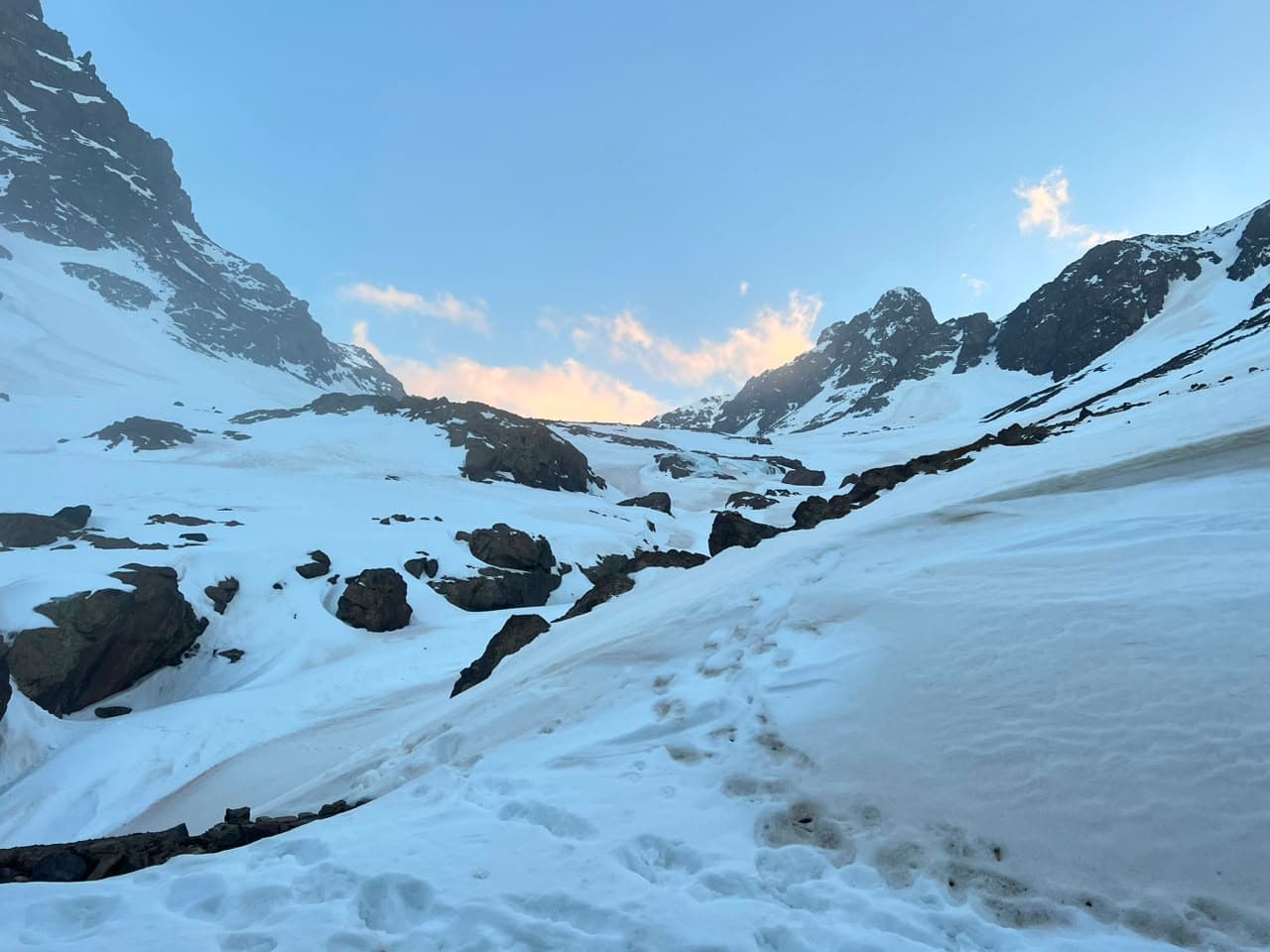
The summit sits 3,700 metres above Marrakech, and the weather reflects that. A month-by-month guide to conditions on Jbel Toubkal, plus live readings from the valley below.
Toubkal's weather is not Marrakech's weather with a jumper on. The summit stands at 4,167 metres, roughly 3,700 metres above the city you flew into, and that vertical distance does more to your day than the calendar month does. People book a summer trek, pack for a summer holiday, and meet freezing wind on a pre-dawn slope. Others write off winter entirely without knowing that it is one of the most spectacular times to be up there, if you arrive equipped.
This guide covers what the mountain actually does through the year, how to read the numbers, and what conditions mean for your kit.
Valley-level reading, updated every three hours via Open-Meteo. The summit runs far colder — see the table below.
Why the valley reading is not the summit reading
Air cools as it rises. As a working rule, every 1,000 metres of ascent drops the temperature by roughly 6 to 10 degrees Celsius, depending on humidity. That single fact explains most of the surprise people experience on Toubkal.
Imlil, the trailhead village, sits at around 1,740 metres. The refuge is near 3,200. The summit is 4,167. So the ground you start on and the ground you finish on are separated by nearly two and a half vertical kilometres.
Work it through on a mild spring day: a pleasant 20°C in Imlil is plausibly around 6°C at the refuge and close to freezing on the summit. Add wind, which the summit ridge rarely lacks, and the temperature your skin registers falls further again. This is why our guides talk about layers rather than a coat.
- Imlil (1,740 m) — where the trail starts. Mildest readings, and the number most weather apps show you if you search for the region.
- Refuge (3,200 m) — where you sleep. Expect a substantial drop from the valley, and cold nights year-round.
- Summit (4,167 m) — around freezing or below for much of the year, wind chill on top of that.
The live panel above reads at valley level. Treat it as a starting point, subtract as you climb, and subtract again for wind.
Toubkal month by month
| Period | On the mountain | What it means for you |
|---|---|---|
| December - February | Deep winter. Snow from the refuge upward, often lower. Summit well below freezing, short daylight | Crampons and an ice axe, and the knowledge to use them. A genuine winter mountaineering trip |
| March - April | Transition. Snow still high on the route, melting below. Weather swings hard week to week | Winter kit often still needed. Conditions must be checked close to the date |
| May - June | The sweet spot opens. Snow retreating off the main route, long daylight, settled spells | The most straightforward summit conditions. Still cold and windy up top |
| July - August | Hottest. Valley heat is significant, summit stays cool. Afternoon cloud build-up common | Start early. The heat problem is on the approach, not the summit |
| September - October | The second sweet spot. Stable weather, cooler valley walking, clear air | Many guides' favourite window. Excellent visibility from the top |
| November | Winter arrives, timing varies year to year | Could be either season. Check conditions rather than assuming |
The two best windows
If you want the highest chance of a comfortable summit without winter equipment, aim for May to June or September to October.
Both give you long daylight, a route largely clear of snow, and settled spells. Autumn has an edge on air clarity — after the summer haze clears you can see an extraordinary distance across the High Atlas from the top.
Mid-summer works, but the problem shifts: the summit is fine while the approach through the valley is hot. That is why summit starts are early, and why the walking day is arranged around the sun rather than around the clock.
Those two windows are also when the refuge fills first. If you are planning around them, the 2-day summit is the shortest route up, and the 4-day trek adds acclimatisation days that make the summit morning considerably more likely to go well.
Winter: not off-limits, just different
From roughly November to March, Toubkal becomes a winter mountain. Snow covers the upper route, the ground underfoot turns hard, and the consequences of a slip change entirely.
This does not put it out of reach. It does mean crampons, an ice axe, and someone with you who knows how to read avalanche and snow conditions. We cover the specifics in Climbing Toubkal in Winter — the short version is that fit beginners do summit in winter, but only with the right equipment and a guide who is qualified for those conditions.
The reward is a genuinely different mountain: fewer people, snow-covered ridges, and light on the summit ridge at dawn that you do not get in August.
Reading conditions before you go
Three things matter more than the headline temperature.
- Wind. The summit ridge is exposed and wind chill routinely does more than air temperature. A calm minus-five is comfortable in the right layers; the same reading with wind is not.
- Fresh snow. Recent snowfall changes both the walking surface and the avalanche picture. This is the single strongest reason to have a guide who has been on the mountain that week.
- Visibility. Above the refuge the route is unmarked. Cloud does not just cost you the view, it costs you the navigation.
None of these show up usefully in a five-day phone forecast for Marrakech. They come from people on the ground, which is part of what you are paying a guide for.
What to pack, by season
Whatever the month, the principle is layers you can add and shed on the move, because you will pass through several climate bands in one day.
- Year-round: thermal base layer, insulating mid-layer, windproof and waterproof shell, hat, gloves, sunglasses, high-factor sunscreen. Altitude sun is fierce even when the air is cold, and snow doubles it by reflection.
- Summer additions: more water capacity than you think, sun protection for the approach, and a warm layer that you will resent carrying until 4 a.m. on summit morning, when it becomes the most important thing in your bag.
- Winter additions: crampons, ice axe, stiff boots that take crampons, heavier insulation, goggles for wind-driven snow.
Our full list is in What to Pack for a High Atlas Trek.
So when should you go?
If you want the simplest possible summit, go in late May, June, September or early October and accept that it will still be cold and windy at the top.
If you want the mountain quiet and dramatic, and you are willing to learn to use an axe and crampons, go in winter with a qualified guide.
If you can only travel in July or August, go anyway — start early, drink more than feels necessary, and treat the valley heat rather than the summit cold as the thing to manage.
The one approach that does not work is treating Toubkal as a warm-country walk because Marrakech was 35°C when you landed. The mountain is a different climate, and the people who struggle are almost always the ones who packed for the city.
March is the month that catches most people out, and it has its own guide:
Frequently asked questions
What is the weather like on Mount Toubkal?
What is the best month to climb Toubkal?
Is there snow on Toubkal in summer?
How cold does Toubkal get at night?
Can you climb Toubkal in winter without special equipment?
Is April, May, September or October a good month for Toubkal?
Trips that go here
Guided by the team who wrote this guide.
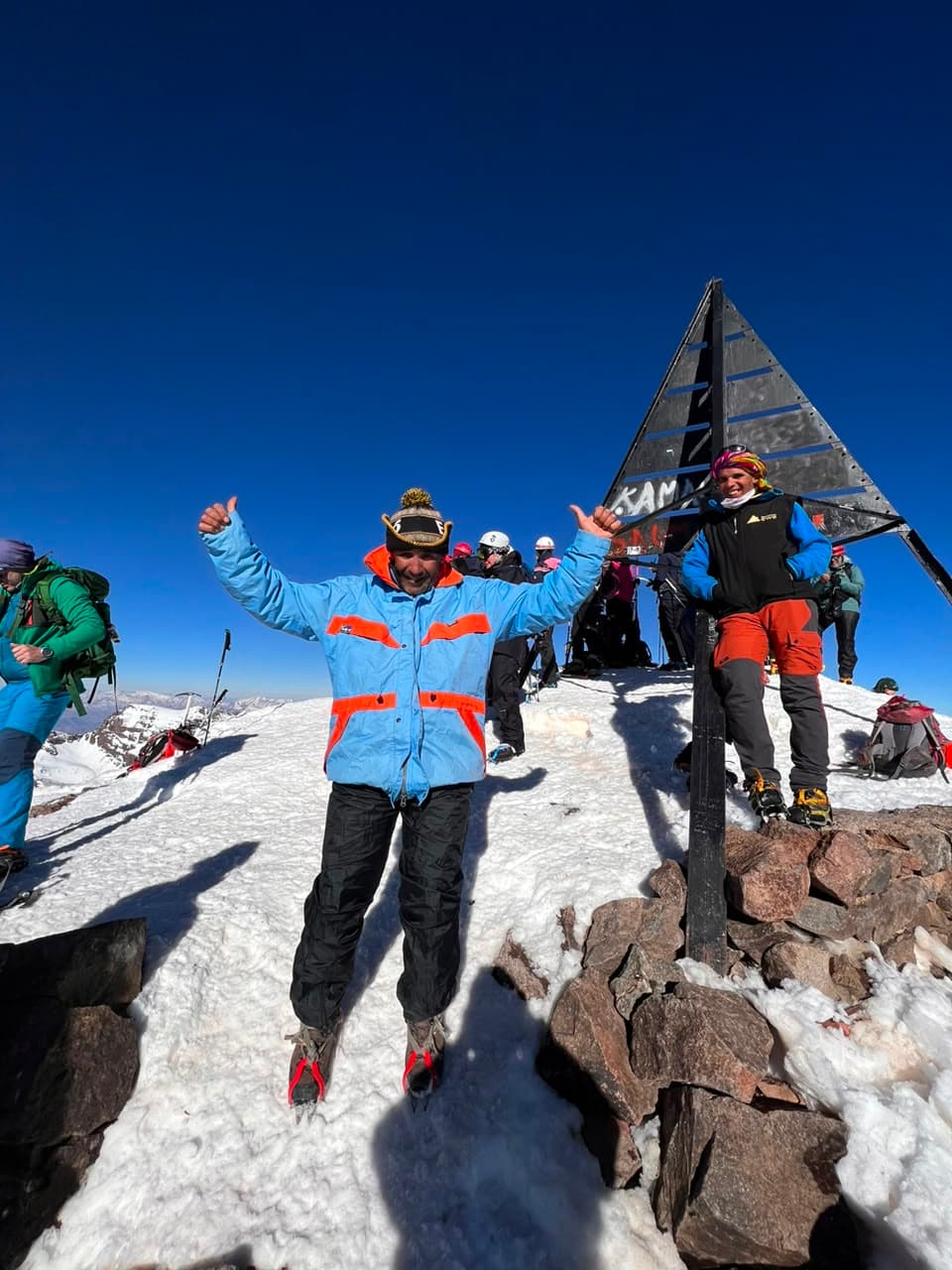
4-Day Toubkal Summit Trek from Marrakech
- Summit Jbel Toubkal at 4,167 m — highest peak in North Africa
- Sleep in traditional Berber mountain refuges at 3,207 m
- Start in the trailhead village of Imlil, deep in the Atlas
€260 / person for 6+
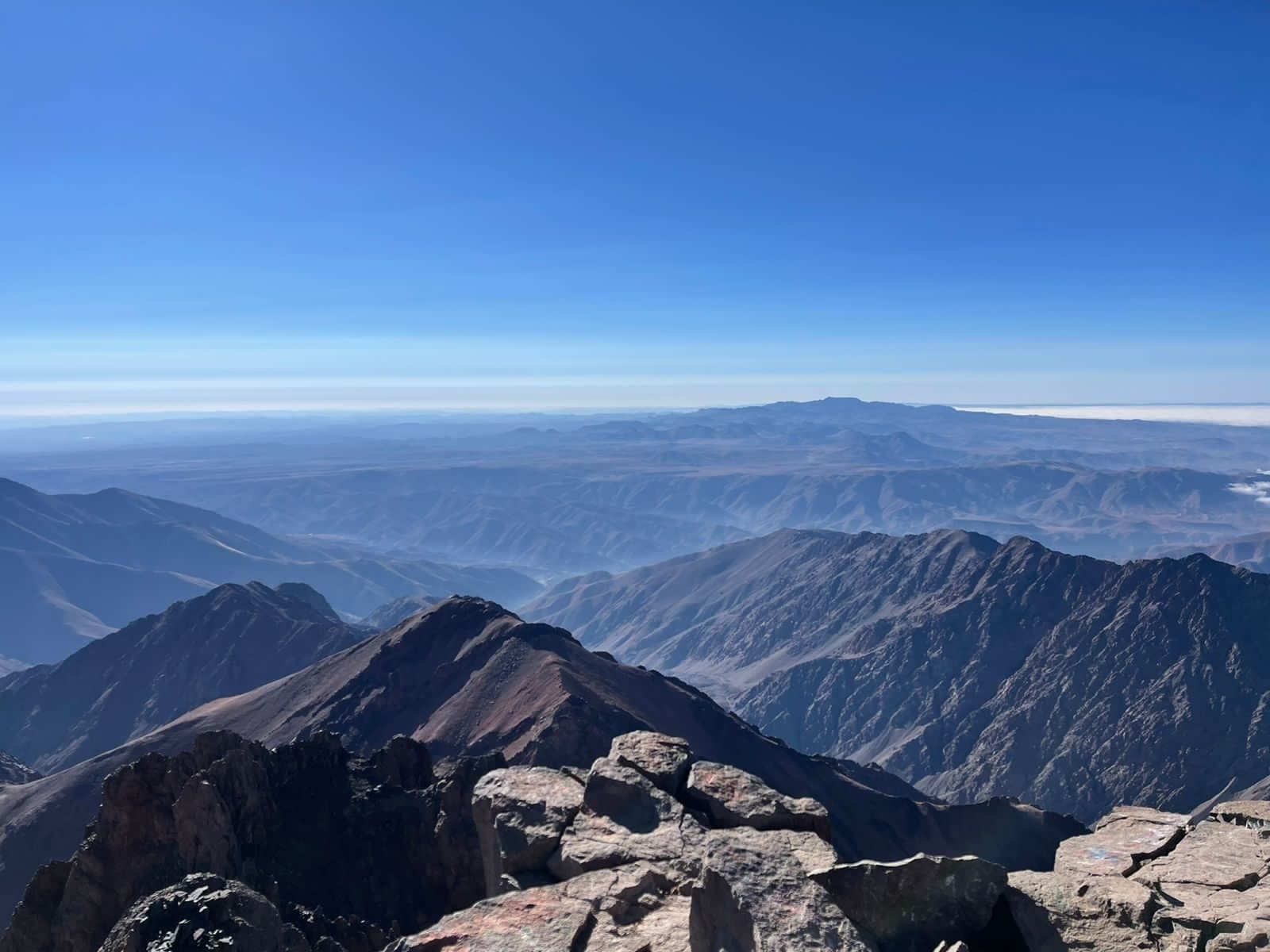
Mount Toubkal Express — 2-Day Summit from Marrakech
- Summit Jbel Toubkal (4,167 m) in just two days from Marrakech
- Overnight in the Toubkal Refuge at 3,207 m
- Pass the Sidi Chamharouch shrine and its waterfall
€153 / person for 6+
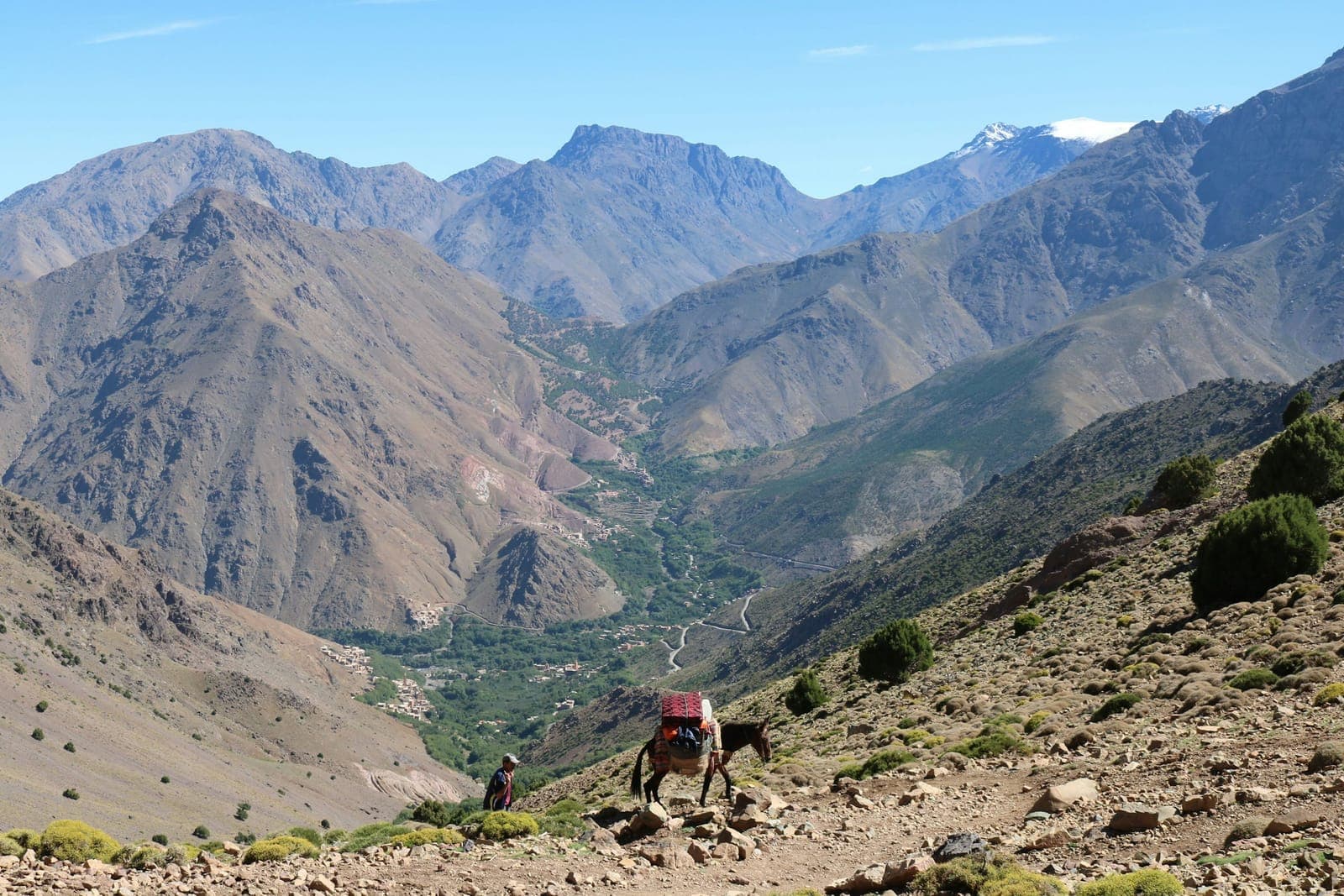
Toubkal Three 4,000 m Peaks from Marrakech — 3-Day Challenge
- Summit three 4,000 m peaks: Timesguida (4,089 m), Ras Ouanoukrim (4,083 m) & Toubkal (4,167 m)
- One of the toughest and most rewarding treks in the High Atlas
- Base from the Toubkal Refuge at 3,207 m
€230 / person for 6+